
- James said real pressure for keepers comes in the silence between shots.
- At Liverpool, City, Portsmouth and England, preparation shaped James.
- For traders too, instinct works only when built on the right information.
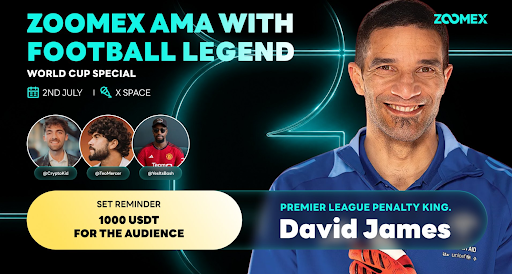
Zoomex hosted the third episode of its World Cup Edition X Space as part of the Zoomex World Cup Impact Pledge, bringing together England goalkeeper David James and a panel of traders: Crypto Kid, Farouk Bashar, and Theo Mercier.
Fernando Aranda hosted the session, which covered the knockout round, penalty psychology, goalkeeping philosophy, and England’s legitimate chances of winning the whole thing, a position James held without qualification and with obvious enjoyment.
The session continued the five-part charity initiative running across the series.
Zoomex is committing 1,000 USDT per episode to a charity of each football guest’s choosing, rising by an additional 5,000 USDT if the prediction proves correct.
James picked England to win the World Cup and nominated the UEFA Foundation as his charity of choice.
Last defence, last line, last save
The episode opened with a question every keeper answers differently, how do you describe the pressure of facing an unrelenting barrage of shots when your team is being outplayed?
James reframed the premise.
“I think the pressure is when you don’t have so much to do. When your team’s attacking and they’re not scoring and it goes down the other end and you’ve got to make the big save. That’s when the concentration has got to be there.”
He carried that logic across a career that spanned Liverpool, Manchester City, Portsmouth, and 53 caps for England.
The goalkeeper who is in the zone does not fear the next shot. He invites it. The trader who has done the homework does not fear the next candle. The preparation has already decided what happens next.
With the Congo goalkeeper the previous night, the opposite had been true. England were creating chances. The keeper was alert because the game required him to be.
“If you’re in the zone, then just keep shooting, keep shooting, because I’m going to be there.”
He was facing volume, but volume keeps a goalkeeper sharp. The danger is the long silence between saves.
The read on the England versus Congo game itself was direct. England won, which was the most important thing, but the Congo goalkeeper was exceptional for sixty or seventy minutes.
He had to be, James said, because England were creating the chances that required exceptional saves.
When Harry Kane’s header went in, and shortly after a thunderbolt from range made it two, the game was decided.
“There was a belief that there was going to be a second. And that’s where, the best goalkeepers in the world, they accept that goals go in, but don’t worry about the scoreline. They just say, OK, that shot beat me. Next shot, I will save. There’s no nerves.”
He was immediately thinking about the next fixture: Mexico at the Azteca. “Other than the final, it doesn’t get much better than that.”
He meant it as a compliment to the occasion, not a warning about the difficulty.
Penalties are about preparation, until they are about instinct
The panel spent substantial time on penalties, partly because the tournament had already produced defining moments in shootouts, and partly because the psychology maps almost exactly onto what traders describe as system versus gut reaction.
James described the two modes a goalkeeper can operate in during a shootout.
The first is pure preparation: the water bottle, the information, the tendencies logged from five or ten previous penalties by the same player, foot placement, the angle of the run-up, which way the non-kicking arm drops, whether there is a stutter in the approach.
All of that gets processed and the goalkeeper explodes at the last possible moment.
The second mode is instinct, and instinct, he said, can be wrong.
“When I thought I was the best goalie in the world and no one was going to beat me and I dived the wrong way, it was all instinct and sometimes your instincts are wrong. The more information you have, arguably, the better your instincts get.”
Crypto Kid connected it immediately.
“That phrase is very applicable to trading as well. Like the more information that you have in front of you, the more data that you can analyse, the better your instinct and ability to predict market movements get.”
Farouk had asked whether the goalkeeper’s rituals and routines in a shootout are natural or practiced. James was clear.
“My practice would be imagining the penalty shoot-out, imagining the crowd, even to the point where, if you’re playing in the Azteca, then you’re imagining being at one end or the other and what this is going to be like. And then you imagine yourself, how do you stand in that goal?”
Jordan Pickford’s approach has evolved over years from shouting and making faces to something more controlled. Whatever the method, James was confident it was rehearsed, not spontaneous.
On Bono specifically, who had already made a reputation in this tournament for his penalty-saving presence, James was thoughtful.
He had watched Bono in the last World Cup doing a particular movement with his feet: stepping one way, going the other. In subsequent shootouts, Bono was doing something slightly different.
“Now I’m thinking he’s doing something different because he knows everyone’s seen what he does. So the next penalty shootout in Morocco, the striker will be saying, “I think I know what you’re doing, but are you going to do something?”
The reputation itself becomes a variable. By the time the striker has processed what Bono is likely to do, Bono has already changed it.
You cannot learn to jump higher, you can learn to prepare better
Theo asked whether James had ever made a save and known in real time that it was a highlight moment.
The answer was yes, occasionally, but less often than people might assume, and for a reason worth sitting with.
“It’s very rare, especially with an experienced goalkeeper to be able to do something that you haven’t done before. You’re not going to be able to jump any higher than you have before. You’re not going to be able to spring. There might be some technical points where you’ve had to move into the position, react.”
The deflection save the Congo goalkeeper made the night before was one of those moments where instinct and body memory combine into something that looks miraculous from outside but feels like execution from inside.
“You look at it and go, OK, I’ve trained really hard to be able to make that save. I’m just so glad I made that save today. Rather than when you’re young and don’t know anything and you go, I’m fantastic, because I’ve never experienced it before.”
The same principle applies to mistakes. James described how the relationship with error has changed across his career and across the sport.
Twenty or thirty years ago, if you made a mistake, you might never see it properly again. It lived in the mind as an impression.
Now, by the hydration break, someone can show you exactly what happened, at what angle, at what moment the decision went wrong.
“A lot of it is, what happened there didn’t make sense. OK, now I know what happened, and you deal with it rather than thinking that it was something that it wasn’t.”
The practical outcome: errors become data rather than ghosts. Farouk brought up Uruguay and Bielsa’s decision to substitute the goalkeeper at half-time.
James had direct experience on the other side of that equation.
As a manager, he once brought a player off after twenty minutes.
“I knew that the game wasn’t going to get any better for the player. So I had to make changes. Fortunately, we ended up winning the game, but I had the conversation and explained why I did what I did.”
The substitution is not the hard part. The communication is. If the reasoning reaches the player, they move forward. If it does not, the confusion becomes a problem that outlasts the match.
France has eight players over 35 kilometres per hour
The question of which teams present the most difficult problems for a goalkeeper led James into statistics in the way he clearly enjoys them.
He had been tracking top-speed data across the tournament.
“If you look at players whose top speed in the World Cup is over 35 kilometres an hour, we have four. France have eight.”
He let the number land. The point was not just the count, but the distribution.
“It’s not just one or two players in similar positions. France is all over the place. They’ve got defenders, they’ve got wingers, they’ve got forwards.”
Whoever faces France in the knockout rounds is not defending against a fast team. They are defending against a team where the fast player could come from anywhere on the pitch at any moment.
His read on Mexico and Spain was built around a different kind of pressure: both teams had not yet conceded in the tournament. That sounds like strength. James described it as a form of fragility.
“When you haven’t conceded, you can think that we are unbeatable. But you can also fear that at some point you will get beaten, and it’s how you respond to conceding that first goal.”
Every other team in the competition had already made the adjustment.
They knew what it felt like to give one up and keep going. Mexico and Spain were still waiting for that moment, and it was coming.
The Cape Verde goalkeeper was the standout individual performance in the tournament so far. Forty years old. Three draws.
The performance against Spain in the first game, James said, was the reason Cape Verde were still in the competition.
“If it wasn’t for that performance against Spain in the first game, they’re going home. They’re going home without that performance. And now they have an opportunity to do something.”
He was waiting for the round of sixteen to identify the tournament’s best goalkeeper with more confidence.
The group stage had been one-sided in too many matches to draw firm conclusions. The round of thirty-two had continued that trend.
When the games tighten, distribution becomes the margin. “All the goalkeepers will be at the top level for the distribution, and the slight nuance in the quality of distribution will be the difference.”
Thierry Henry and Didier Drogba: Two of the loveliest guys you will ever meet
Fernando asked who made him most nervous across a career: the striker or midfielder who made him want to avoid the fixture.
“I was never nervous. I was just always disappointed.”
Then the answer: Thierry Henry and Didier Drogba. “Whenever it didn’t matter how good I felt. When I left the pitch, they’d won the game and usually one of them had scored.”
The frustration was not about fear. It was about the gap between preparation and outcome. He could feel ready. He could feel certain. And by the final whistle, one of them had still scored.
The more difficult detail: “Fernando, they are two of the loveliest guys you’re ever going to meet, which is even worse, because you want them to be horrible.”
He was clearer on goalkeeping evolution when Farouk raised the question. The rule changes have done more to alter the position than any tactical development.
When goal kicks moved from the box to open play, every goalkeeper had to develop a passing range that the position had never previously required. Distribution became structural rather than optional.
“When it comes to the actual physical side of goalkeeping, I’ve not seen any real evolution at all.”
The jumps are the same. The dives are the same. What has changed is the demand placed on the goalkeeper’s feet and decision-making inside the build-up.
He is pursuing his coaching badges partly to investigate whether the physical side of the position has scope for genuine development that the sport has not yet found.
Outfield, something has clearly happened. Players like Barcola and Dembélé are doing things at pace and in tight spaces that the best players in the world were not doing ten years ago.
Whether the goalkeeping position has evolved to match the players now running at it from eight different directions is a question James does not think has been fully answered.
England until we lose, and we have not lost
On England’s tournament prospects, James held the position he had taken before the first ball was kicked and was not moving from it.
Every argument that could be made for Spain, France, Brazil, or Argentina, he said, could be made equally for England. Until England lose, England are in it.
“I just think this year, this tournament, it’s all about England. So that’s my winner.”
He had watched Jude Bellingham pick up the Congo goalkeeper after a save, a moment of what he called friendly frustration, the recognition between two professionals that the other had done the job right.
Harry Kane had stepped up when it mattered. “For successful teams to be successful, there’s moments when the player steps up. And last night, Harry Kane stepped up.”
Crypto Kid supplied the external validation from outside the session: it is coming home, as the Prime Minister had apparently confirmed.
The panel’s own predictions spread across the obvious candidates. Theo saw Argentina or France one level above the rest. Farouk backed France on the basis of consistent performance across the group stage.
Crypto Kid was hoping for Argentina. Theo, asked to defend Brazil, admitted with some resignation that Brazil had the players but possibly not the structure.
On the prediction market, Olise was the consensus pick for top assists, with France likely to go deep enough in the tournament to give him the opportunities.
Mbappé and Messi split the golden boot votes.
The system does not have emotions, neither should you
James connected the work of a goalkeeper to the work of a trader in a way that the panel immediately recognised. Preparation decides the outcome before the event begins. Instinct is what preparation becomes when time runs out.
Crypto Kid had been thinking about the same parallel across the session.
“The more information that you have in front of you, the more data that you can analyse, the better your instinct and ability to predict market movements get. So it’s actually super, super related.”
The goalkeeper with the water bottle is running the same process as the trader who has backtested the position before opening it. The reading is faster at the moment because the thinking has already happened.
Farouk asked about goalkeeping rituals and whether they are learned or natural.
James’s answer extended into how the best professionals in any field develop their pre-performance routine: they rehearse the situation before it arrives, including the crowd, the specific stadium, the possible shooter, the possible market condition.
The routine is not superstition. It is a prior simulation under controlled conditions so that the real moment does not arrive as a surprise.
James’s closing advice to the audience was built on the same structure.
“I’ve done all my homework. Yes, I got the right result, but it’s because I’ve done my homework. Rather than when you’re young and don’t know anything and you go, I’m fantastic. It’s a lesson more about preparing yourself to do that than it is expecting something to happen that you’ve never practised or prepared for.”
He finished with a promise to return to the Zoomex X Space after swimming in Trafalgar Square fountain following England’s victory. Fernando said he would take a flight to be there.
The lesson from the Zoomex space
The thread that ran through the entire session was the relationship between information, preparation, and the moment of execution.
James’s career was built on narrowing that gap. A penalty is not decided when the ball is struck.
It is decided in the days of study that precede the shootout, in the mental rehearsal of the crowd, the shooter, the foot placement, the moment of explosion.
The moment itself is fast. The preparation is long. When the preparation is thorough, the fast moment goes the right way more often than it does not.
The traders described the same architecture. Farouk and Theo both described coming to the market with a position built before the session opens, and the discipline of not overriding that position when emotion says otherwise.
The goalkeeper who dives before the moment of information has arrived goes the wrong way on instinct alone. So does the trader who opens a position without a stop loss because the stomach says to hold.
David James’s specific answer to why he was never nervous, only ever disappointed, is worth sitting with.
He was disappointed because the preparation was thorough and the outcome still went against him. He was not nervous because nervousness means the preparation was incomplete.
The job of preparation is to remove the unknowns that produce nerves, and replace them with a plan that decides what happens when the situation changes.
The plan does not eliminate losing. It eliminates panicking while losing.
The Zoomex World Cup Impact Pledge continues across two more episodes. England are going to win the World Cup. David James said so, and 1,000 USDT for the UEFA Foundation is waiting on the other side of it.
About Zoomex
Founded in 2021, Zoomex is a global cryptocurrency trading platform with over 3 million users across more than 35 countries and regions, offering 600+ trading pairs.
Guided by its core values of “Simple × User-Friendly × Fast,” Zoomex is committed to fairness, integrity, and transparency in delivering a high-performance, low-barrier, trustworthy trading experience.
As an official partner of the Haas F1 Team and global brand ambassador partner of goalkeeper Emiliano Martínez, Zoomex brings the same focus on speed, precision, and discipline from the racetrack and the pitch to trading.
The platform holds regulatory licenses including Canada MSB, U.S. MSB, U.S. NFA, and Australia AUSTRAC, and has passed security audits conducted by Hacken.
This article is authored by a third party, and CoinJournal does not endorse or take responsibility for its content, accuracy, quality, advertisements, products, or materials. Readers should independently research and exercise due diligence before making decisions related to the mentioned company.