
Key Takeaways
- Chad Barraford says recovery hinges on 2 chokepoints: exchanges and fiat off-ramps.
- Public tracing across neutral protocols allow investigators to label and monitor stolen funds in real time.
- Thorchain will maintain its permissionless structure despite rising pressure on DEX platforms.
Resistance to Wallet-Blocking Demands
Thorchain co-founder and lead developer Chad Barraford criticized the crypto industry’s tendency to shift focus from compromised exchanges to the protocols used by hackers to move stolen funds. According to Barraford, this misdirected focus stems from the transparent nature of decentralized plumbing, which makes tracing stolen assets visible to everyone.
Still, Barraford told Bitcoin.com News that while he sympathizes with victimized exchanges, he refuses to play a blame game, preferring instead to focus on how digital asset recovery actually works.
Barraford’s remarks come amid controversy over Thorchain’s steadfast refusal to honor a request by Bitget CEO Gracy Chen to freeze hacker-linked wallets. Chen made the request a few days after suspected North Korea-backed hackers stole over $388 million in digital assets from Bitget. While Chen frames the move as an essential defense against bad actors laundering funds on decentralized exchanges (DEX), Thorchain maintains that preserving permissionless, decentralized infrastructure takes priority.
This is not the first time Thorchain, which has been live since 2021, has resisted external pressure. In 2025, the protocol faced intense scrutiny after rebuffing a request by Bybit, supported by the FBI, to blacklist wallet addresses tied to state-sponsored North Korean cybercriminals.
Yet, as on-chain sleuths looked on in frustration while alleged North Korean cybercriminals moved at breakneck speed to launder stolen funds, calls for DEX oversight have only intensified. This growing scrutiny has led Barraford to forcefully dispel the notion that protocols like Thorchain have built-in switches to selectively blacklisted wallets.
“That switch does not exist, and it was never built, on purpose,” Barraford said.
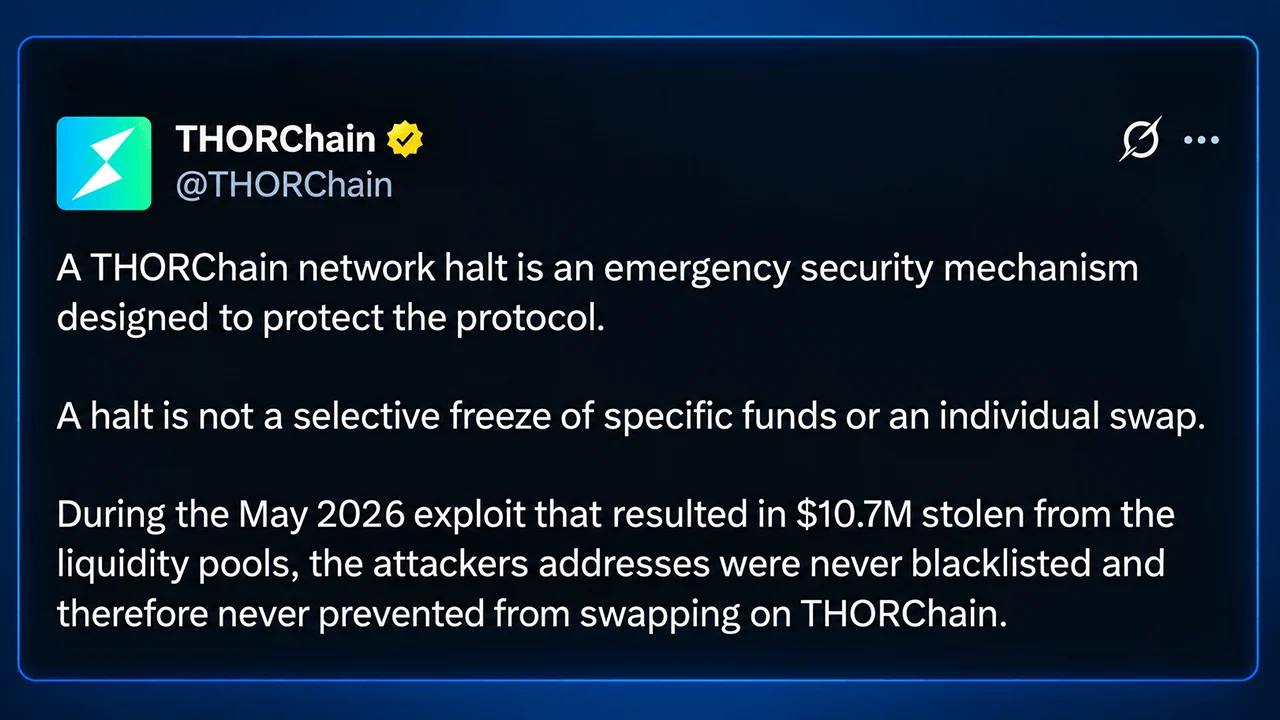
Nevertheless, DEXes like Thorchain do have an emergency halt, but according Barraford, this is a blunt instrument which operators can use to pause trading across the whole network or on a particular chain if the protocol itself is under threat.
“It stops everyone at once. It’s a circuit breaker, not a scalpel. There is no function to reach in, single out one person’s transaction, and deny it while everyone else keeps trading,” he explained.
Building selective blocking features, Barraford argues, would inherently create censorship capabilities and empower a select few to decide whose funds can move. The entire point of the network is to ensure no one holds that kind of power:
“So when we say we can’t selectively block an address, we mean can’t, not won’t.”
The Unavoidable Cost of Protocol Neutrality
Addressing the broader debate over whether permissionless networks should block specific transactions, Barraford emphasized that critics often confuse what a protocol should do with what it can do. He argued that cross-chain swap layers must remain as neutral as Bitcoin miners or Ethereum validators to retain user trust.
Warning that building censorship tools inevitably leads to misuse, the co-founder acknowledged that maintaining a neutral network comes with unavoidable tradeoffs.
“So my honest position is that neutrality has a real cost, and I won’t pretend it doesn’t,” Barraford said. “It means the network gets used by people you’d rather it wasn’t. I think that cost is worth paying, because the alternative is worse for exactly the people the system is meant to protect.”
As cybercriminals adopt artificial intelligence (AI) tools to widen their attack surface, centralized exchanges face an escalating threat environment. While DEXes inevitably draw heat when stolen funds flow through their rails, Barraford maintains that such backlash is misdirected, arguing that asset recovery rarely, if ever, occurs at the swap layer.
“It happens at the edges, where crypto touches the traditional financial system. Exchanges, fiat off-ramps, the regulated chokepoints where someone has to identify themselves to cash out,” the co-founder said.
These financial gateways represent the true friction points: the exact locations where assets can be frozen and where authorities possess actionable leverage.
On the other hand, DEXes and public infrastructure provide transparency by keeping network swaps visible, allowing investigators to track funds, label addresses, and monitor transactions in near-real time. According to Barraford, this transparency should be viewed as an asset and not a liability:
“The tracing works precisely because the rails don’t hide anything. Closing them wouldn’t stop theft; it would just make the money harder to follow.”