Key Takeaways
- Binance’s reported $6.3 billion breach has eclipsed previous cryptocurrency thefts in dollar terms, but historical bitcoin losses paint a different picture.
- Mt Gox, Bitfinex and other early incidents involved extraordinary quantities of BTC whose hypothetical present-day valuations dwarf their original losses.
- Recoveries, customer reimbursements and the proportion of assets affected complicate the question of which cryptocurrency hack was truly the most damaging.
Binance’s $6.3 Billion Disaster Puts Crypto’s Biggest Heists Under the Microscope
Cryptocurrency has produced fortunes, technological breakthroughs, and an extraordinary collection of security disasters. Some attacks exploited sophisticated vulnerabilities in blockchain infrastructure, while others relied on stolen credentials, compromised private keys, or weaknesses in the human beings entrusted with protecting billions of dollars.
The latest reported incident involving Binance has pushed those historical comparisons back into the spotlight. According to the latest findings, approximately $6.3 billion to $6.4 billion in digital assets was removed from Binance wallets on Oct. 29, 2026, potentially making it the largest cryptocurrency theft ever recorded by dollar value. The figures remain provisional, and the estimates attributed to blockchain analytics firms should not be confused with the findings of a completed forensic investigation.
Yet dollar figures only tell part of the story. Bitcoin’s enormous appreciation over the past decade means an incident that looked comparatively modest when it occurred can dwarf today’s billion-dollar exploits when measured in the quantity of BTC stolen. Meanwhile, the amount initially taken does not necessarily represent the ultimate financial damage, particularly when assets are frozen, recovered, or reimbursed.
The 20 Largest Crypto Hacks Ranked by Dollar Value
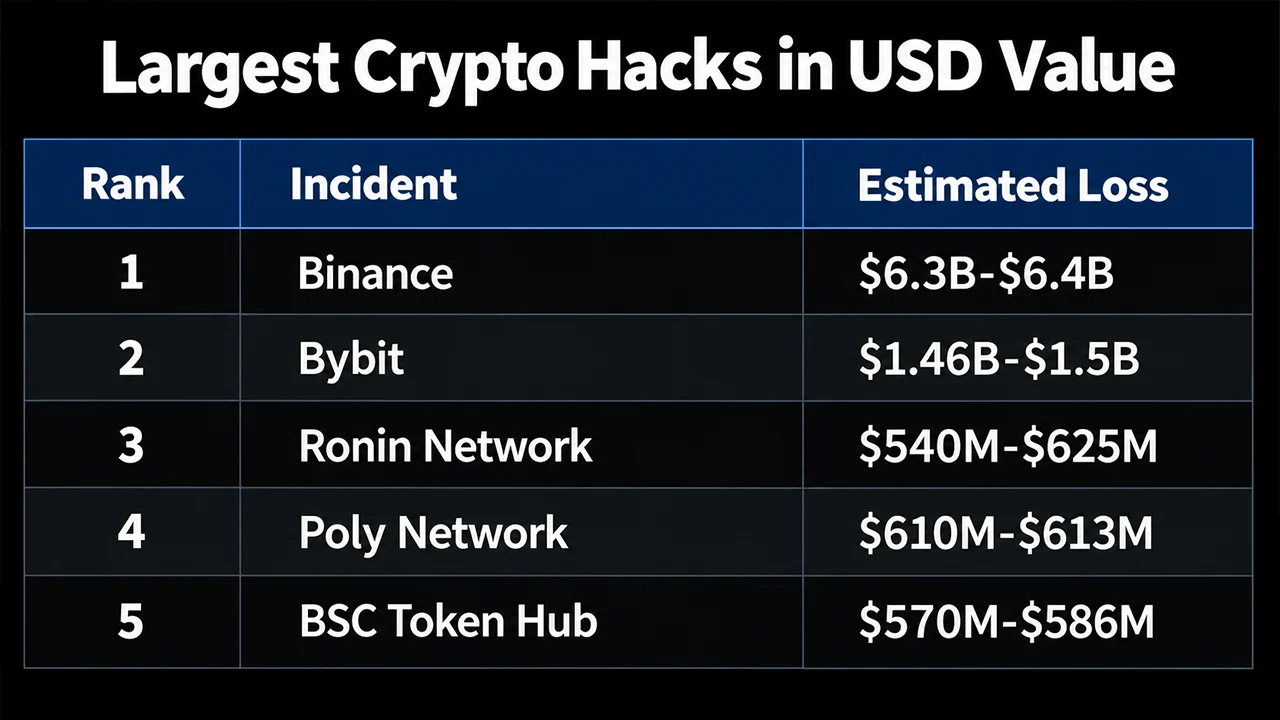
The first comparison ranks cryptocurrency thefts by their estimated U.S. dollar values at the time of each incident rather than present-day valuations. It includes exchange breaches, bridge exploits, and unauthorized transfers, although the circumstances of certain cases complicate their classification as conventional hacks. Recoveries and reimbursements are treated separately from the initial amounts compromised.
| Rank | Incident | Estimated Loss |
|---|---|---|
| 1 | Binance | $6.3B-$6.4B |
| 2 | Bybit | $1.46B-$1.5B |
| 3 | Ronin Network | $540M-$625M |
| 4 | Poly Network | $610M-$613M |
| 5 | BSC Token Hub | $570M-$586M |
| 6 | Coincheck | $530M-$534M |
| 7 | FTX | $450M-$477M |
| 8 | Mt. Gox | $473M |
| 9 | Bitget | $351.6M-$387.5M |
| 10 | Wormhole | $320M-$326M |
| 11 | Liquid Network | $320M |
| 12 | DMM Bitcoin | $305M-$308M |
| 13 | KelpDAO | $292M |
| 14 | Drift Protocol | $285M-$295M |
| 15 | KuCoin | $150M-$280M |
| 16 | WazirX | $230M-$235M |
| 17 | Cetus Protocol | $223M |
| 18 | Mixin Network | $200M |
| 19 | Euler Finance | $197M |
| 20 | Nomad Bridge | $190M |
The first striking observation is the distance separating Binance from the rest of the field. Its reported $6.3 billion loss is more than four times the value of Bybit’s February 2025 breach, previously regarded as the industry’s largest single cryptocurrency theft by dollar value.
But even the headline totals demand scrutiny. The BSC Token Hub exploit, for example, involved approximately $570 million in newly minted BNB, although substantially less was successfully moved beyond the affected ecosystem. Similarly, the Poly Network attacker eventually returned most of the stolen assets, illustrating the considerable difference between the initial value compromised and the amount permanently lost.
Binance, Bybit and the Billion-Dollar Era
The Oct. 29 Binance incident represents a new magnitude of reported exchange security failure. Blockchain investigators traced approximately $6.3 billion in transfers across nearly a dozen blockchains, including Ethereum, Bitcoin, Tron, and Solana. Onchain slueths further identified 18,270 BTC among the stolen assets and attributed the operation to North Korea’s Tradertraitor group. Binance, meanwhile, pledged to cover customer balances through its emergency reserves and corporate resources, while partners reportedly froze approximately $3 billion in affected assets.
The Bybit breach on Feb. 21, 2025, previously occupied the top position. Attackers compromised the transaction approval process during an ether cold-wallet transfer, making a malicious transaction appear legitimate to authorized signers. Approximately 400,000 ETH and related assets, valued at around $1.46 billion to $1.5 billion, were stolen. The FBI subsequently attributed the attack to North Korean operatives, while Bybit secured additional liquidity to honor customer withdrawals.
Ronin, Poly Network and the Bridge Exploits
Ronin Network’s March 2022 attack demonstrated how a limited number of compromised validator keys could compromise an entire bridge. Attackers obtained control over five of nine validators and withdrew 173,600 ETH alongside 25.5 million USDC. Depending on the valuation date, the stolen assets were worth approximately $540 million to $625 million. U.S. authorities attributed the operation to North Korea’s Lazarus Group.
Poly Network suffered a different kind of disaster in August 2021. A flaw in the cross-chain protocol’s access controls permitted unauthorized transfers valued at approximately $610 million. Unlike most large cryptocurrency thefts, however, the attacker subsequently returned nearly all the assets, transforming what initially appeared to be a catastrophic loss into one of the industry’s most unusual recovery episodes.
The BSC Token Hub incident in October 2022 involved a vulnerability that permitted the unauthorized creation of 2 million BNB. Although those tokens carried a nominal value approaching $570 million to $586 million, only a fraction escaped the ecosystem before intervention. That distinction matters because newly minted tokens valued at market prices are not necessarily equivalent to immediately realizable proceeds.
Coincheck, FTX and Mt Gox
Japan’s Coincheck lost approximately 523 million NEM tokens in January 2018 after attackers compromised a hot wallet. The assets were worth roughly $530 million at the time, making the incident one of the largest exchange breaches of its era. Coincheck subsequently compensated affected customers using company funds.
FTX experienced an estimated $450 million to $477 million in unauthorized cryptocurrency transfers during its November 2022 collapse. The withdrawals occurred amid bankruptcy proceedings and an extraordinary breakdown in corporate controls. Because the incident coincided with broader insolvency and alleged misuse of customer assets, some historical rankings exclude it from conventional hacking comparisons.
Then there is Mt Gox, whose historical importance is almost impossible to capture using its original dollar valuation. The exchange disclosed approximately 850,000 missing BTC in 2014, including customer and corporate holdings, before locating roughly 200,000 BTC in an old wallet. The initial shortfall was valued around $473 million at bankruptcy, but the remaining loss of approximately 650,000 BTC has become vastly more consequential as bitcoin’s market price has appreciated.
Bitget, Wormhole and Liquid Network
Bitget’s reported September 2026 incident initially carried an estimated value of $351.6 million, subsequently revised to approximately $387.5 million after investigators identified additional affected assets. The supplied research describes compromised withdrawal infrastructure and says the exchange intended to use its protection fund to cover customer losses. Attribution to North Korean actors remains an assessment rather than a confirmed official finding.
Wormhole lost approximately $320 million to $326 million in February 2022 when attackers exploited a signature-validation vulnerability to create 120,000 wrapped ETH without the required backing. Jump Crypto later replenished the missing collateral, preventing the exploit from becoming an equivalent permanent loss for users.
The September 2026 Liquid Network incident involved approximately 4,000 BTC, with the supplied account describing the actors as white-hat hackers who later returned 3,400 BTC. That account requires careful treatment: the claimed return substantially changes the economic impact, and the research does not provide a complete primary-source reconstruction of the event.
DMM Bitcoin, KelpDAO and Drift Protocol
DMM Bitcoin lost 4,502.9 BTC in May 2024, valued at approximately $305 million to $308 million. Investigators tied the theft to North Korean social engineering targeting a wallet-management provider. The Japanese exchange ultimately arranged customer compensation and wound down its operations, showing how a security incident can become an existential business problem even when reimbursement is promised.
Two reported incidents in April 2026 added another estimated $577 million to the industry’s security bill. KelpDAO suffered an approximately $292 million compromise involving off-chain infrastructure, while Drift Protocol lost an estimated $285 million to $295 million. Investigators suspected North Korean involvement in the Drift incident, although the attribution remained provisional in the supplied material.
Kucoin, WazirX, Cetus, Mixin, Euler and Nomad
Kucoin’s September 2020 breach involved compromised hot-wallet private keys and estimates ranging from $150 million to $280 million in affected assets. The exchange subsequently reported recovering a substantial proportion of the funds through tracking, freezes, and cooperation with other platforms, illustrating how coordinated responses can reduce an attack’s lasting financial consequences.
WazirX suffered approximately $230 million to $235 million in losses in July 2024 after a multisignature wallet was compromised. The incident disrupted withdrawals and trading, triggering restructuring and recovery efforts. The attack was attributed to the Lazarus Group, with the custody arrangement itself becoming a central focus of scrutiny.
The remaining cases illustrate how vulnerabilities extend well beyond centralized exchanges. Cetus Protocol’s May 2025 exploit involved approximately $223 million, while Mixin Network reported roughly $200 million in losses in September 2023. Euler Finance lost approximately $197 million in March 2023 through a flash-loan-assisted exploit, although negotiations ultimately resulted in the return of roughly 90% of the stolen funds. Nomad Bridge, meanwhile, suffered an approximately $190 million exploit in August 2022 after a message-validation weakness allowed fraudulent withdrawals.
The Biggest Bitcoin Thefts Tell an Entirely Different Story
Dollar-denominated rankings favor more recent incidents, when cryptocurrency markets commanded substantially higher valuations. Measuring historical thefts by the number of bitcoin stolen produces a dramatically different hierarchy, one dominated by early exchange breaches, compromised wallets, and losses that occurred when BTC traded at a fraction of its present-day price.
For comparison, the ranking table below uses a fixed reference price of $78,000 per bitcoin. These calculations are hypothetical valuations of historical BTC quantities, not estimates of the assets still controlled by attackers or the amounts that could realistically be recovered.
| Incident | BTC Stolen | Value at $78,000 |
|---|---|---|
| Mt Gox | 850,000 | $66.30B |
| Lubian (disputed) | 127,426 | $9.94B |
| Bitfinex | 119,756 | $9.34B |
| Linode-linked thefts | 46,653 | $3.64B |
| Allinvain wallet | 25,000 | $1.95B |
| Bitstamp | 18,866 | $1.47B |
| Binance (2026) | 18,270 | $1.43B |
| Cryptsy | 13,000 | $1.01B |
| Binance (2019) | 7,000 | $546M |
| DMM Bitcoin | 4,502.9 | $351.2M |
| Liquid Network | 4,000 | $312M |
| Mintpal | 3,894 | $303.7M |
This comparison changes the entire historical hierarchy. Mt Gox’s original reported shortfall of 850,000 BTC would carry a hypothetical valuation of $66.3 billion at $78,000 per coin, more than ten times the estimated dollar value of the October 2026 Binance incident. Even the approximately 650,000 BTC remaining after the old-wallet discovery would be worth $50.7 billion at the same reference price.
The 2016 Bitfinex theft also becomes considerably more imposing when measured in bitcoin. Attackers took 119,756 BTC, worth approximately $72 million at the time. At the reference price used in this analysis, the same quantity would be worth approximately $9.34 billion, although U.S. authorities subsequently seized a substantial portion of the stolen coins.
Lubian Mining presents another extraordinary but disputed case. Arkham Intelligence alleged that 127,426 BTC was stolen from the mining operation in December 2020 because of weaknesses in private-key generation. The alleged loss would be worth approximately $9.94 billion at $78,000 per coin. However, unresolved questions about ownership, the mechanism, and later U.S. seizure proceedings mean it should not be presented as a conclusively established exchange or mining-pool hack.
Early cryptocurrency history also includes the Linode-linked thefts affecting several businesses in 2012, the reported loss of 25,000 BTC from the wallet known as Allinvain in 2011, and incidents involving Cryptsy, Bitstamp and Mintpal. These cases were financially smaller at contemporary bitcoin prices, but their BTC quantities are enormous compared with many modern exploits.
Binance’s October 2026 incident also warrants inclusion in the bitcoin-denominated comparison, with the exchange recording 18,270 BTC among the assets transferred during the reported outflows. That is separate from the approximately 7,000 BTC stolen from Binance in May 2019. The newer incident’s bitcoin component alone would be worth about $1.43 billion at the $78,000 reference price, although its overall dollar value was driven by a much broader collection of digital assets.
CZ Says the Largest Dollar Theft Is Not the Largest Bitcoin Theft
Binance founder Changpeng Zhao, widely known as CZ, addressed the distinction between dollar-denominated losses and bitcoin quantities in a statement supplied for this report. His argument centers on a deceptively simple point: the biggest headline figure does not necessarily identify the most consequential incident for users, markets or the cryptocurrency supply.
“Saw a few discussions about size of hack, why impact to bitcoin price is small, etc. $6.3 billion is the biggest in USD terms, but not in BTC terms. MtGox was 650,000 BTC,” Zhao wrote on X. “Other important numbers to consider: % of bitcoin (in relation to BTC total supply), ie, market impact. MtGox is big there again at 5%+. Number of users impacted, and % of user assets impacted. MtGox (the largest CEX at the time) and FTX (not small) were all near 100% of users and their [assets].”
CZ added:
“Most important: Who is impacted? Does the platform cover it all? (only one victim), as in recent two CEX cases and Binance. Obviously, still a major disaster for the industry, Binance (and me). It hurts, but we survive. Most importantly, we protect our users.”
The statement, reproduced as supplied, raises an important question about how the industry measures security failures. Gross theft figures describe the assets compromised, but they do not reveal how much customers ultimately lose, whether the affected company remains solvent or how much of the stolen cryptocurrency can be recovered.