
Key Takeaways
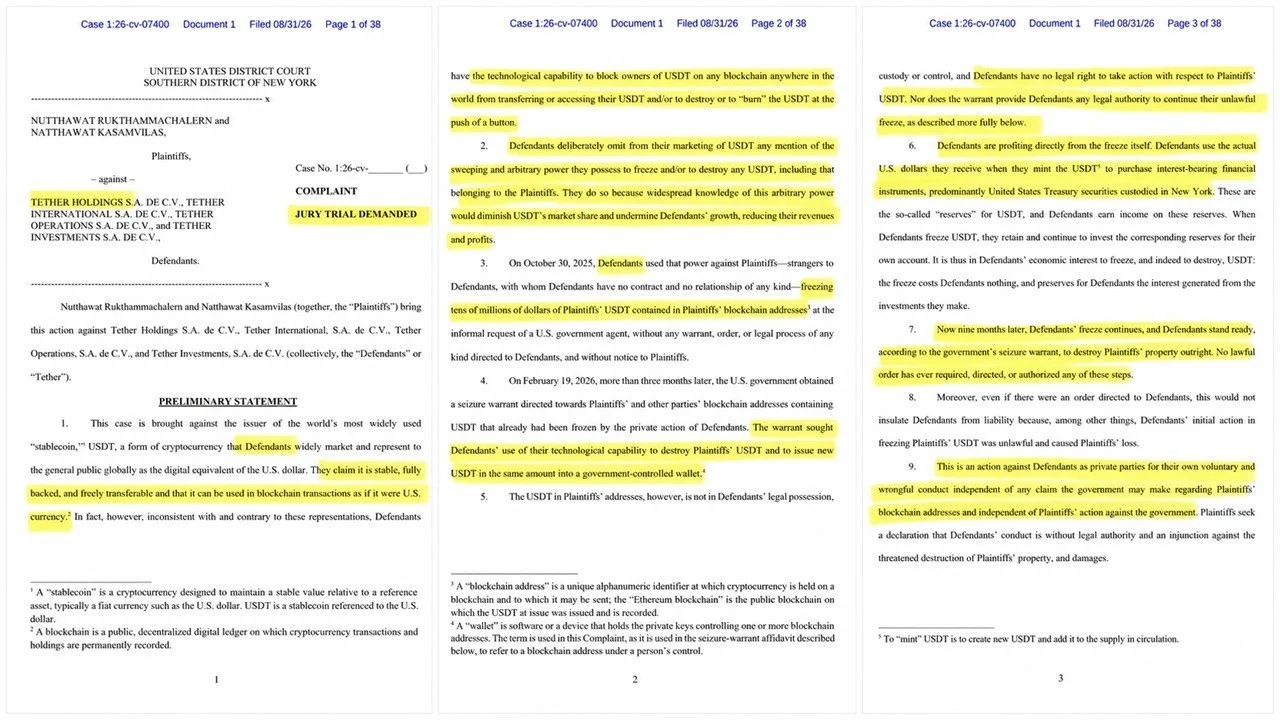
- Tether froze $42.4 million in USDT tied to two Thai investors on Oct. 30, 2025, per the suit.
- A seizure warrant didn’t arrive until Feb. 19, 2026, nearly four months after the freeze.
- Plaintiffs want the blacklist lifted, damages paid, and Tether’s reserve income disgorged.
A Freeze Before Any Warrant
Nutthawat Rukthammachalern and Natthawat Kasamvilas filed suit against Tether on Aug. 31 in the U.S. District Court for the Southern District of New York, arguing the stablecoin issuer had no legal basis to lock down their funds. According to the complaint, Tether blacklisted ten Ethereum addresses holding a combined $42,417,785.62 in USDT on Oct. 30, 2025, months before any warrant existed.
That warrant eventually came from a different case entirely. A magistrate judge in the Eastern District of North Carolina issued seizure warrant No. 5:26-MJ-1267-JG on Feb. 19, 2026, tied to a pig-butchering investment scam investigation. Investigators alleged the wallets in question had received proceeds from romance-driven crypto fraud schemes. The plaintiffs say they weren’t part of that scheme and had no notice of the freeze until well after their funds were already locked.
The lawsuit lands on a company that freezes funds routinely, given Tether has coordinated with OFAC and U.S. law enforcement on some of the largest asset freezes in stablecoin history, including a $344 million freeze in April tied to illicit activity, and a stretch in May where the company blacklisted 371 addresses and froze roughly $515 million in USDT over just 30 days.
Tether says it has supported thousands of law enforcement cases globally, but the company’s unilateral freezing power, baked into USDT’s smart contract via a centralized administrative key, is exactly what this new suit is challenging.
What the Plaintiffs Want
The complaint seeks declaratory relief, an injunction, damages, disgorgement of any income Tether earned on reserves backing the frozen tokens, and punitive damages. The plaintiffs specifically want Tether barred from burning or reissuing the disputed USDT while the case is pending, and they’re asking the court to force removal of their addresses from the blacklist.
This isn’t their first attempt at relief. On July 31, they filed a separate application in North Carolina seeking the return of the funds, but neither that proceeding nor the New York suit has produced a ruling on ownership or Tether’s liability.
How Pig-Butchering Freezes Get Complicated
Pig-butchering scams typically involve fraudsters building months-long fake relationships with victims before steering them into bogus crypto investment platforms, and investigators often trace the stolen funds through dozens of wallets before landing on the ones worth freezing.
The tracing part is where things get a little complicated, as the North Carolina warrant covered a broader sweep in which prosecutors say more than $61 million in USDT was tied to wallets linked to investment fraud, but the Thai plaintiffs argue their ten addresses got swept up in that dragnet without any individualized evidence connecting them to the scheme.
Whether the wallets genuinely touched any scam-related proceeds, or simply transacted with addresses that had done so themselves somewhere down the line, is likely to be the central factual fight as the case moves forward. Interesting few months ahead!