
Key Takeaways
- Stablecoin supply dropped $15 billion since May, the largest fall since Terra’s 2022 collapse.
- Tether’s USDT and Circle’s USDC accounted for most of the $15 billion decline in July 2026.
- Tokenized Treasuries neared $17 billion as GENIUS Act rules pushed yield-seeking cash off stablecoins.
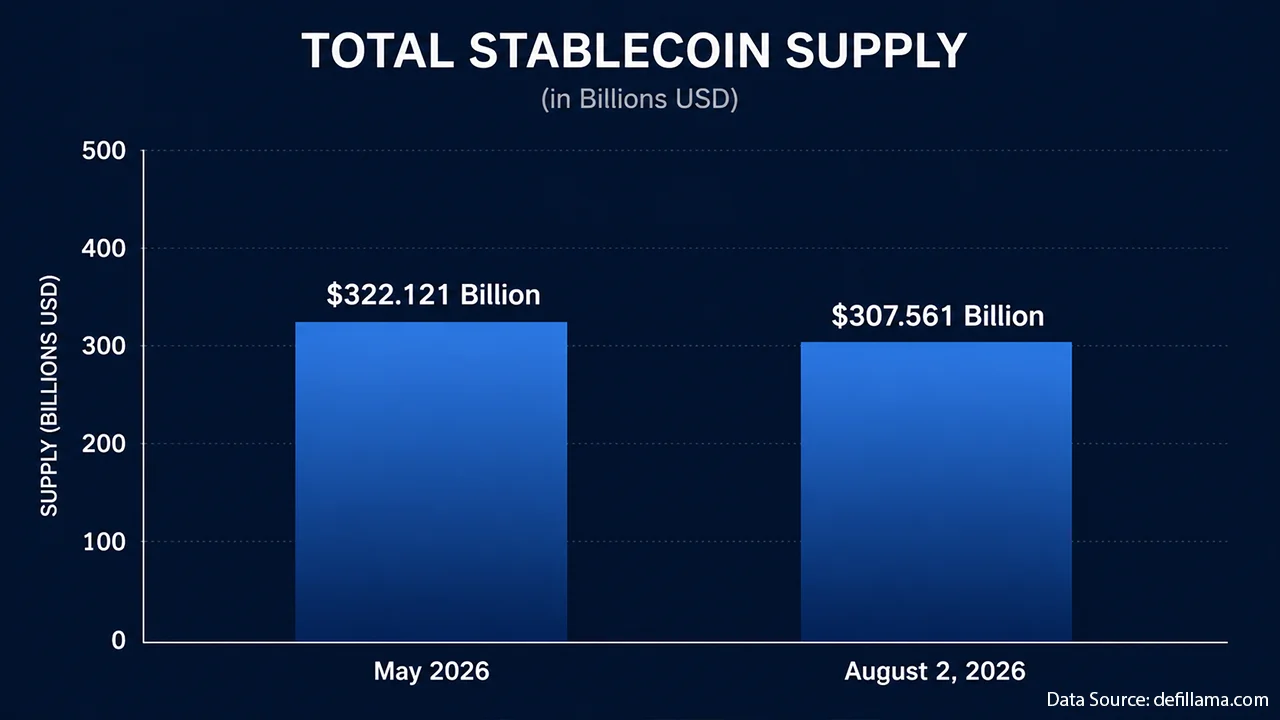
Total stablecoin supply topped out near $322.121 billion in mid-May 2026, according to stablecoin market data from defillama.com, before giving back more than $14 billion in less than three months. June delivered the heaviest blow, wiping out approximately $11.41 billion in a single month, the steepest monthly contraction since TerraUSD imploded in May 2022. By August 2, 2026, total stablecoin supply had fallen to roughly $307.561 billion.
Tether Sheds Billions as Circle Follows Close Behind
Tether’s USDT, the largest stablecoin, fell from roughly $189 billion in early May to about $183.216 billion by August 2. Circle’s USDC dropped from a March peak near $80 billion to around $72.069 billion over the same stretch. Together, the two tokens account for most of the industry’s decline, though smaller players, including Sky’s USDS and Ethena’s USDe, also posted double-digit percentage losses.
Not every token lost ground. Global Dollar, known as USDG, grew during the pullback, and several tokenized cash products kept gaining users even as the broader category contracted.
Washington’s New Rules Push Cash Toward Treasuries
The GENIUS Act, signed into law in July 2025, set the first federal framework for payment stablecoins. It bars licensed issuers from paying interest or yield tied to holding or using their tokens. The Office of the Comptroller of the Currency (OCC) reinforced that stance with proposed rules early in 2026, treating stablecoins as transaction tools rather than savings accounts.
That shift matters because investors who once parked idle cash in USDT or USDC to earn yield no longer have that option. Many have moved instead into tokenized U.S. Treasury and money-market products, which grew to the high teens of billions of dollars by late July. Broader tokenized real-world asset (RWA) holdings topped $32 billion in some counts.
Falling Crypto Prices Add to the Pressure
Bitcoin and other major cryptocurrencies dropped significantly in value during the second quarter of 2026, cooling the trading activity that normally keeps demand for stablecoins high. Fewer trades mean less need for stablecoins as collateral. New rules under Europe’s Markets in Crypto-Assets regulation, which restricted some noncompliant tokens on European exchanges, added further pressure in that region.
Record Transaction Volume Tells a Different Story
Even as the total float shrank, activity on stablecoin networks hit a record, according to the official Visa Onchain Analytics Dashboard (powered by Allium Labs). Adjusted transaction volume reached about $1.8 trillion in June 2026, up roughly 63% from the previous month. USDC processed about $1.21 trillion of that volume despite having a smaller total supply than USDT, which processed about $576 billion.
As shown in the screenshot above, the Visa and Allium Labs dashboard shows that, over the past 30 days, stablecoins settled $5.2 trillion in onchain transactions across 1.6 billion transfers, highlighting their growing role in digital payments. After filtering out non-economic activity, adjusted volume reached $1.3 trillion across 214.1 million transactions. Retail-sized transfers accounted for $7.1 billion in value and 144.6 million transactions, showing that everyday users continue to make up a significant share of stablecoin activity.
Issuers Adjust as Interest Income Fades
For companies that issue stablecoins, the change reshapes how they make money. Interest earned on reserves backing a large token supply matters less now. Transaction fees, distribution deals, and compliance track records matter more. USDC has gained ground in trading volume relative to its size, and newer regulated issuers continue to compete for market share at the margins.
Card networks Visa and Mastercard have both reported rising stablecoin settlement activity, a sign that the tokens are increasingly used to move money rather than simply held.
What to Watch as the Market Adjusts
Analysts expect the current pullback to remain contained rather than spread into a broader crisis, unlike the 2022 collapse that involved TerraUSD’s total failure and the bankruptcy of FTX. Risks ahead include further regulatory changes around yield workarounds, trouble at a major issuer, or a deeper drop in crypto prices that speeds up redemptions.
Potential catalysts for growth include clearer rules under the GENIUS Act, continued expansion of tokenized Treasury products, and renewed trading activity that rebuilds demand for stablecoins as collateral. Stablecoin supply has more than doubled over the past several years despite the recent pullback, and a similar-sized drop between December 2025 and February 2026 reversed within months.