
Key Takeaways
- A 2019-era Quant wallet sent 9,000 QNT to Coinbase and Kraken on Sept. 29 at about $222 per token.
- QNT ran from about $61 on Sept. 16 to $373 on Sept. 27 after The Clearing House picked Quant.
- Four linked wallets still hold 25,200 QNT, worth near $6.2 million, after the Sept. 28 split.
The Alert That Lit up QNT Twitter
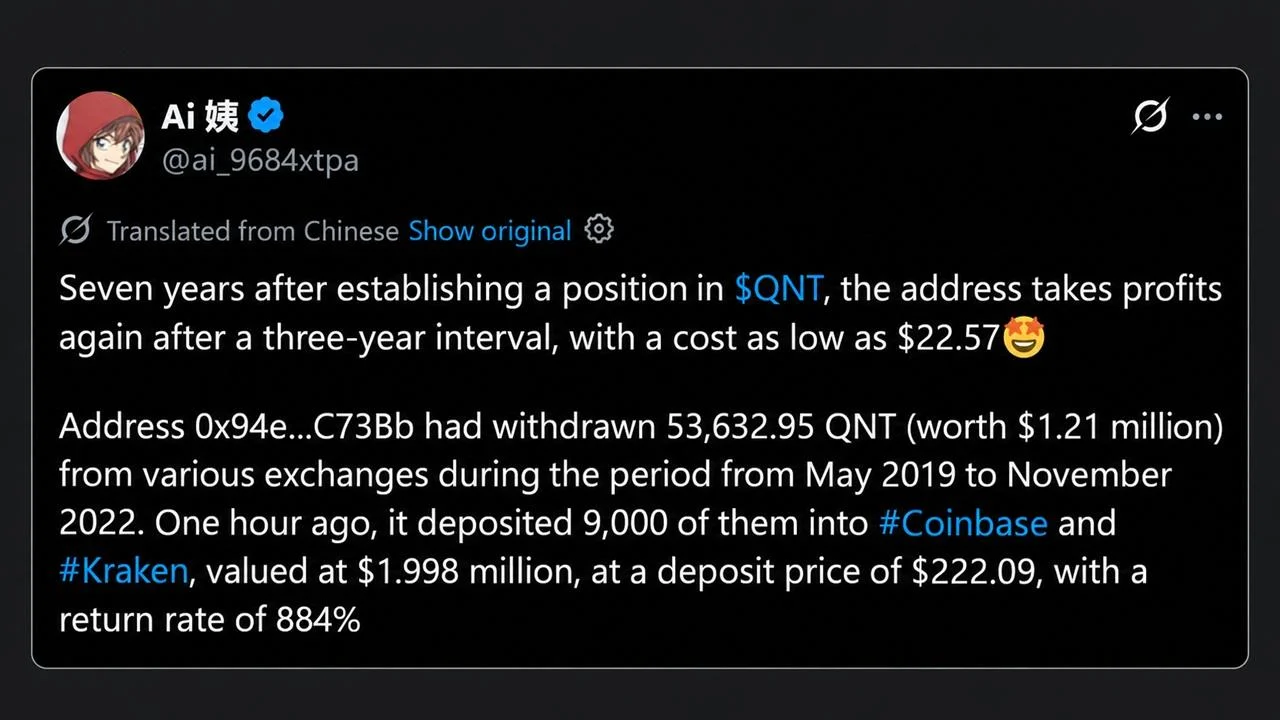
Onchain trackers flagged the deposits early Tuesday, calling the wallet a seven-year position and pegging the average entry at $22.57. The tracker said the entity had withdrawn 53,632.95 QNT, then worth about $1.21 million, from major exchanges between May 2019 and November 2022.
The latest batch landed at a deposit price of $222.09, per the post, which works out to the 884% return that got screenshotted everywhere. The Arkham address page shows how the coins were split:
- Two Coinbase deposits of 4,000 and 3,000 QNT
- One 2,000 QNT deposit to Kraken.
How Did the Coins Get There?
While the alert makes it sound like one wallet did everything, that wasn’t the case. A quick look at the trail on Blockscout goes back to an original 2019 wallet that took in QNT in batches from May 2019 through January 2021, plus two top-ups in November 2022, and then sat mostly idle.
- June 2019: 10,000 QNT went to a Bittrex deposit address, the first trim.
- Oct. 17, 2022: 6,821 QNT went to Binance while QNT traded between $190 and $228, two days after Bitcoin.com News reported that QNT hit a 10-month high.
- Dec. 8, 2022: another 2,570 QNT went to Binance, with the token near $120.
- Sept. 28, 2026, 22:15-22:39 UTC: the old wallet emptied itself into four fresh addresses, in slices of 10,001, 4,199.95, 10,000 and 10,000.01 QNT.
- Sept. 29, 00:35-01:31 UTC: two of those new wallets fed the exchange deposits.
In other words, this holder trimmed into the 2022 rally, waited nearly four years, and is now trimming into another rally the same way. Splitting a stash across new addresses right before selling is a common way to keep order sizes small and leave less of a public paper trail.
Why QNT, and Why This Week?
The trigger was a Clearing House announcement on Sept. 24. The U.S. bank-owned payments operator picked Quant to run the coordination layer of its On-Chain Money Initiative, a network for tokenized deposits, meaning bank deposits represented as digital tokens that can settle instantly. The system connects to the RTP and CHIPS rails and targets a launch in the first half of 2027.
The same day, UK Finance confirmed live tokenized sterling payments on Quant’s platform with Barclays, HSBC UK, Lloyds, Natwest and Santander. QNT went from about $61 on Sept. 16 to an intraday high of $373 on Sept. 27, about 13% short of its 2021 peak of $430. QNT also shot to the top of Coingecko’s trending list.
All of that happened while bitcoin’s price barely moved, spending the week pinned near $83,000. Bitcoin.com News reported that it held above $83K even as 13,800 BTC left Binance in a single day. Early Tuesday, roughly $500 million in leveraged positions were liquidated as bitcoin’s price dipped under that level. QNT, by contrast, was trading near $268 on the day (roughly four times its mid-September price).
The Bots Showed up too
The new wallets drew unwanted attention within hours, as has become quite common these days. To elaborate, between 04:41 and 05:35 UTC, the wallet that sent 2,000 QNT to Kraken logged zero-value QNT transfers to two addresses whose first and last characters mimic the real Kraken deposit address.
The process is referred to as address poisoning, where a scammer plants a look-alike address in a wallet’s transaction history and hopes the owner copies it on the next transfer. With 8,000 QNT still in that wallet, one careless paste would be an expensive mistake.