
Key Takeaways
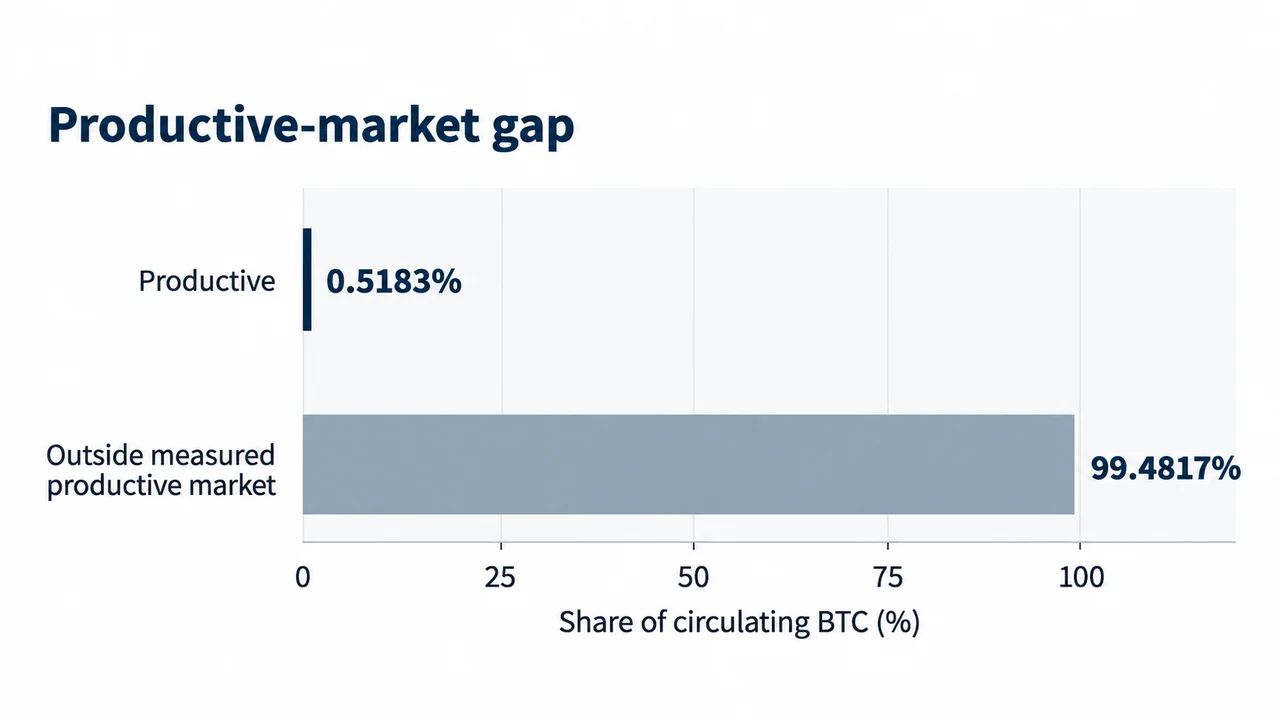
- Just 104,105 BTC, nearly 0.52% of the circulating bitcoin supply, is deployed in productive onchain strategies.
- Lending dominates BTCFi at 81%, while low yields keep most bitcoin outside DeFi.
- The key test now is whether BTCFi can persuade long-term holders to put more bitcoin to work.
Bitcoin’s $8.4B Yield Market Leaves 99% of Supply Untapped
Bitcoin may be the largest asset in crypto, but very little of it is actually working onchain to produce yield for holders.
A joint report from Yield Basis and Valueverse found that just 104,105 BTC was deployed in productive strategies as of Sept. 20, equal to roughly $8.7 billion and only about 0.52% of circulating supply.
That means more than 99% of bitcoin remains outside yield-generating DeFi strategies.
The gap is striking because bitcoin has already been widely tokenized. Wrapped assets including WBTC, cbBTC, and tBTC together represent more than 218,000 BTC-equivalent units. Yet only around 35% of that wrapped bitcoin is currently deployed productively, per the report.
Lending Dominates BTCFi, but Yields Remain Thin
The current BTCFi market is heavily concentrated in lending.
According to the report, lending accounts for 81% of productive BTC, while staking and restaking make up another 12%. Liquidity strategies remain much smaller.
Conventional liquidity provision represents about 5.5% of productive BTC, while impermanent-loss-protected models account for just 1.3%.
That reflects a central problem for bitcoin holders: lending yields are extremely low, averaging around 0.01%, because demand to borrow BTC itself remains limited.
DEX liquidity can pay more through trading fees, but impermanent loss has held adoption back. Only about 7,000 BTC is currently deployed across decentralized exchanges.
Yield Basis Bets on Liquidity Without Impermanent Loss
Yield Basis is positioning itself around that constraint. The protocol uses leveraged Curve Cryptoswap positions and automated rebalancing to generate yield from trading and arbitrage activity while attempting to neutralize impermanent loss.
Since launch, Yield Basis said it has supported more than $4.32 billion in aggregate activity, generating $2.4 million in realized yield and roughly $180,000 in unrealized fee gains for liquidity providers by the end of Q2 2026.
Its BTC-wrapper markets delivered fundamental returns of roughly 2.50% to 2.91% during the first half of the year, the firm said, while unstaked liquidity token redemption returns ranged from 2.60% to 3.00%. The protocol now represents about 19% of all BTC deployed across decentralized exchanges (DEXs), according to the report.
Productive Bitcoin Could Reach 270,000 BTC by 2030
Valueverse estimates the productive bitcoin market could grow to around 270,000 BTC by 2030 under a base-case scenario. A more bullish case puts the figure near 470,000 BTC.
The larger opportunity is not moving BTC between existing DeFi protocols; it is convincing long-term holders to deploy coins that currently sit idle.
For BTCFi, that is the real prize.
Bitcoin does not need significantly more tokenization to unlock the next phase of growth. It needs existing bitcoin holders to believe that onchain yield is worth the risk.