
Key Takeaways
- AI gains increased technology exposure inside mainstream funds.
- Pension savers may hold substantial AI exposure indirectly.
- The Sept. 14 sell-off revealed the risks of unintended concentration.
How AI Exposure Builds Inside Ordinary Savings
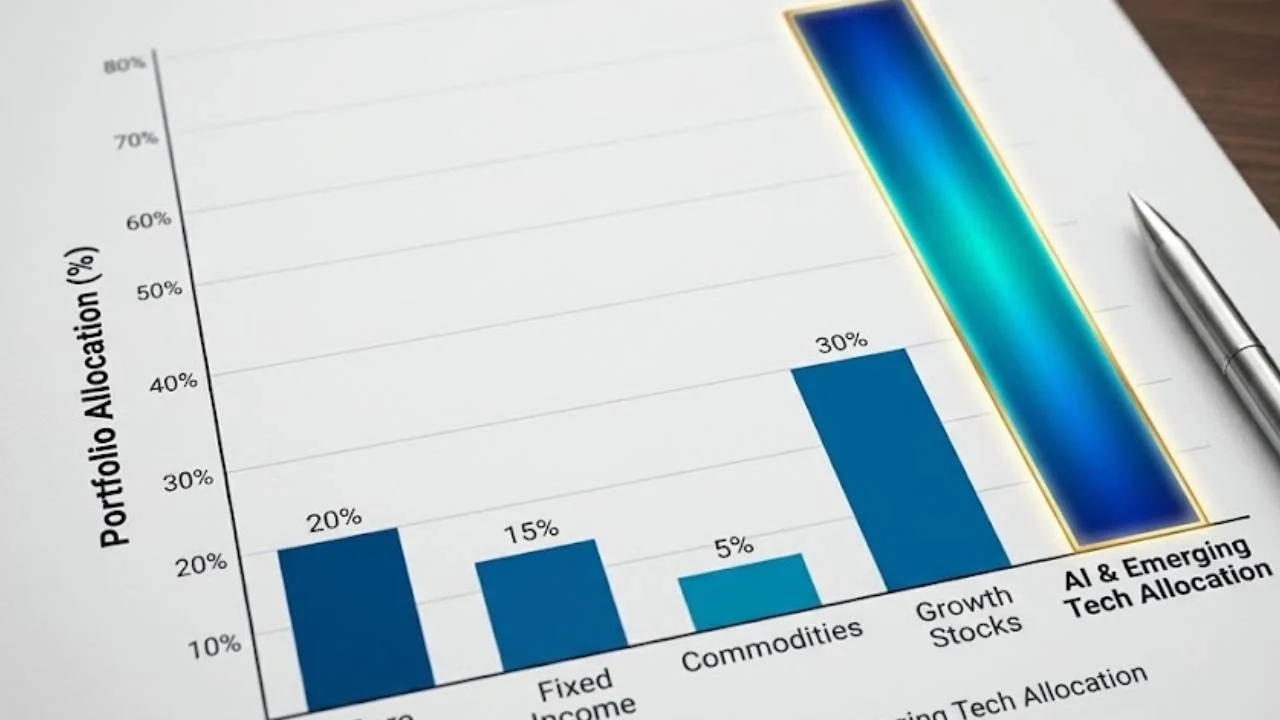
Everyday savers can accumulate AI-heavy portfolios without purchasing shares in an artificial intelligence company. Nigel Green, CEO of Devere Group, a financial advisory company, issued the warning on Sept. 14. He argued that a long run of AI-driven earnings growth has carried the same theme into funds and pensions never presented to savers as concentrated technology holdings.
Broad investment products can hold hundreds of companies while remaining heavily influenced by their largest constituents or a dominant earnings theme. An exchange-traded fund holds a basket of assets, but its underlying holdings, weighting method, and strategy determine its actual exposure. That structure allows AI concentration to develop even when the saver never selects an individual technology stock.
The concentration can build gradually as strongly performing holdings occupy a greater share of an investment portfolio. A Sept. 2 examination of record household equity exposure and stock concentration cited Federal Reserve data showing that directly and indirectly held corporate equities represented 46.71% of U.S. household financial assets at the end of 2025. The Fed’s Sept. 11 revision now puts the Q4 2025 figure at 45.42%, while the latest Q2 2026 reading is 48.23%.
Green stated:
“Somebody who has never bought a tech stock in their life can still be sitting on a concentrated AI position through their pension.”
AI Warnings Expose the Concentration Risk
Technology shares across Asia, Europe, and the United States fell Sept. 14, revealing how quickly a single investment theme can affect mainstream savings. The Nasdaq composite fell as much as 1.3% before closing 0.6% lower, while Nvidia, the heaviest weight on the market, sank 3.4%. SoftBank closed 10.7% lower in Tokyo, South Korea’s Kospi lost 3.3%, and Dutch chip equipment maker ASML declined 6%.
The sell-off followed a Sept. 12 essay in which Anthropic CEO Dario Amodei proposed pacing frontier AI development to give alignment and safety work more time to catch up with advancing capabilities. Amodei emphasized that pacing would not halt model training or technical progress. OpenAI CEO Sam Altman subsequently supported the proposal.
Green interpreted the market reaction as a warning about concentrated portfolio exposure rather than a rejection of AI’s long-term prospects, stating: “Markets are treating this as straightforward bad news for anything tied to AI spending. It’s the wrong lens entirely.”
Slower Development Does Not Eliminate Computing Demand
New safety controls do not automatically remove demand for computing capacity, judging by OpenAI’s own disclosure. The company reported on Sept. 6 that GPU allocation to one restricted model class fell a further 59.2% in the week after security limits took effect Aug. 7, while allocation to other classes rose 17.2%, offsetting about 85% of the decline.
The scale of the AI infrastructure buildout further illustrates how widely the investment theme reaches across financial markets. Nvidia and six financial institutions signed memorandums of understanding to establish platforms designed to mobilize more than $500 billion in third-party capital for AI infrastructure over time. The proposed arrangements involve Blackrock, Blackstone, Goldman Sachs, Apollo, Brookfield, and KKR, and remain subject to execution of final agreements.
Computing demand has also connected bitcoin miners, power suppliers, data-center operators, and semiconductor companies to the same investment cycle. A July rally produced double-digit gains across numerous mining and AI infrastructure stocks. “Slowing the race to build smarter models doesn’t slow demand for running the models already out there,” Green explained. He concluded:
“Reviewing that exposure doesn’t require predicting where AI development goes from here. It requires an honest look at how a portfolio got built, and whether the concentration inside it was ever a deliberate decision.”