Key Takeaways:
- WLFI dropped over 19% this week, hitting an all-time low of $0.07726 amid Dolomite borrowing controversy.
- USD1, World Liberty Financial’s stablecoin, grew 476.3% to $4.186B, now the 6th-largest stablecoin.
- ABTC, TRUMP, and MELANIA are all down 84%–99% from highs, with retail holders absorbing most losses.
The First Project: The Original NFT Card Collection
Although discussion around the controversy remains active, this piece adopts a strictly explanatory posture, centering its analysis purely on data, metrics, and performance. One of the earliest ventures tied to U.S. President Donald Trump was his non-fungible token (NFT) card collection.
The NFT series debuted in December 2022, followed by additional releases in the months that followed. Trump also told the press that the original NFT collection was the catalyst that shifted his perspective, drawing his attention to bitcoin and blockchain technology. The initial NFT drop, issued on Polygon, consisted of 45,000 cards portraying Donald Trump across a spectrum of stylized personas and outfits (superhero, astronaut, etc.).
Each card was offered at $99, and as of this weekend, the collection’s price floor sits at $64.55 per card, marking a decline of 34.8%. Among today’s NFT offerings, the original Trump NFT trading cards hold the #97 position within the top 100 collections, according to nftpricefloor.com.
World Liberty Financial (WLFI) – DeFi Platform, WLFI Governance Token, and USD1 Stablecoin
World Liberty Financial (WLFI) is a decentralized finance (DeFi) initiative established in 2024 that aims to connect traditional finance (TradFi) with blockchain-based systems. At present, the project offers two primary products: a stablecoin known as USD1 and a governance token called WLFI. Operational oversight is reportedly handled by Zachary (Zak) Folkman, Chase Herro, Alex Witkoff, and Zach Witkoff. According to a Wall Street Journal (WSJ) report, the Trump family receives 75% of the net proceeds from token sales, along with additional incentives.
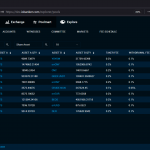
The project’s USD1 stablecoin has posted notable expansion, and as of April 11, 2026, it ranks as the sixth-largest stablecoin by market capitalization. Data compiled by defillama.com places USD1’s current market cap at $4.186 billion. On April 29, 2025, that figure stood at $726 million, indicating a 476.3% increase in less than a year. The asset remains primarily concentrated across two dominant networks, with BSC ( BNB) accounting for 42.74% and Ethereum close behind at 37.55%.
Solana constitutes the third-largest ecosystem for the token, capturing 19.02% of its distribution. The remainder is dispersed across a range of smaller integrations, including Aptos (0.34%), Tron (0.24%), and Abcore (0.09%), while networks such as Monad (0.01%) and Plume Mainnet (less than 0.0001%) hold only marginal shares of the overall market cap. In total, roughly 80% of the supply is concentrated on BSC and Ethereum.
The WLFI token, launched Sept. 1, 2025, is now tradable across multiple chains and incorporates community-driven governance. The firm has also introduced WLFI Markets, which facilitates lending and borrowing through the third-party platform Dolomite, alongside the Agentpay SDK designed for AI agents, as well as bridge and conversion tools.
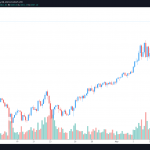
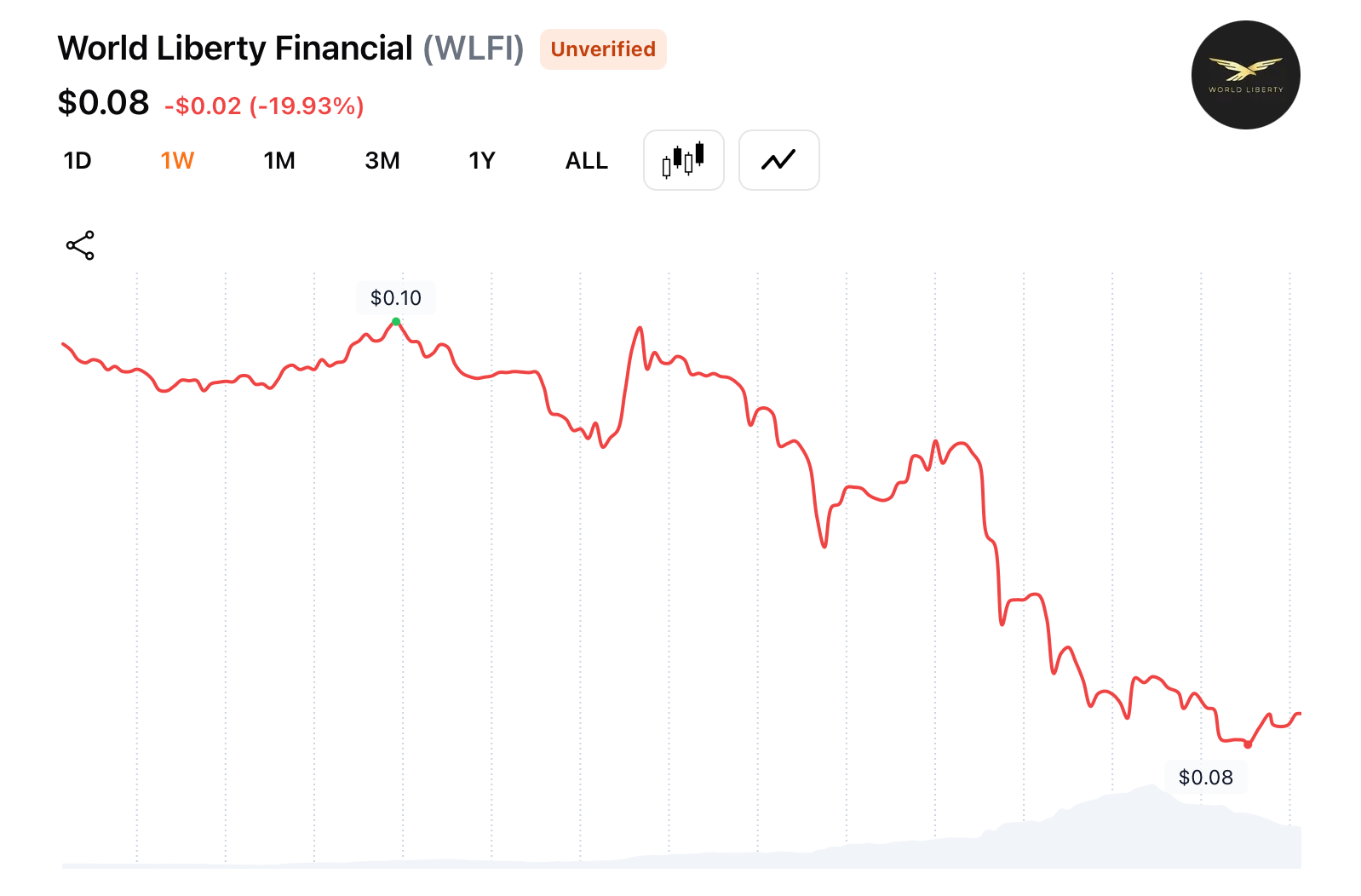
At press time, the token is priced at $0.07998 per coin after shedding more than 19% this week. Roughly eight hours ago, WLFI touched an all-time low of $0.07726 and remains only marginally above that level at press time. The token is also down 75.9% from its $0.3313 peak recorded on Sept. 1, 2025.
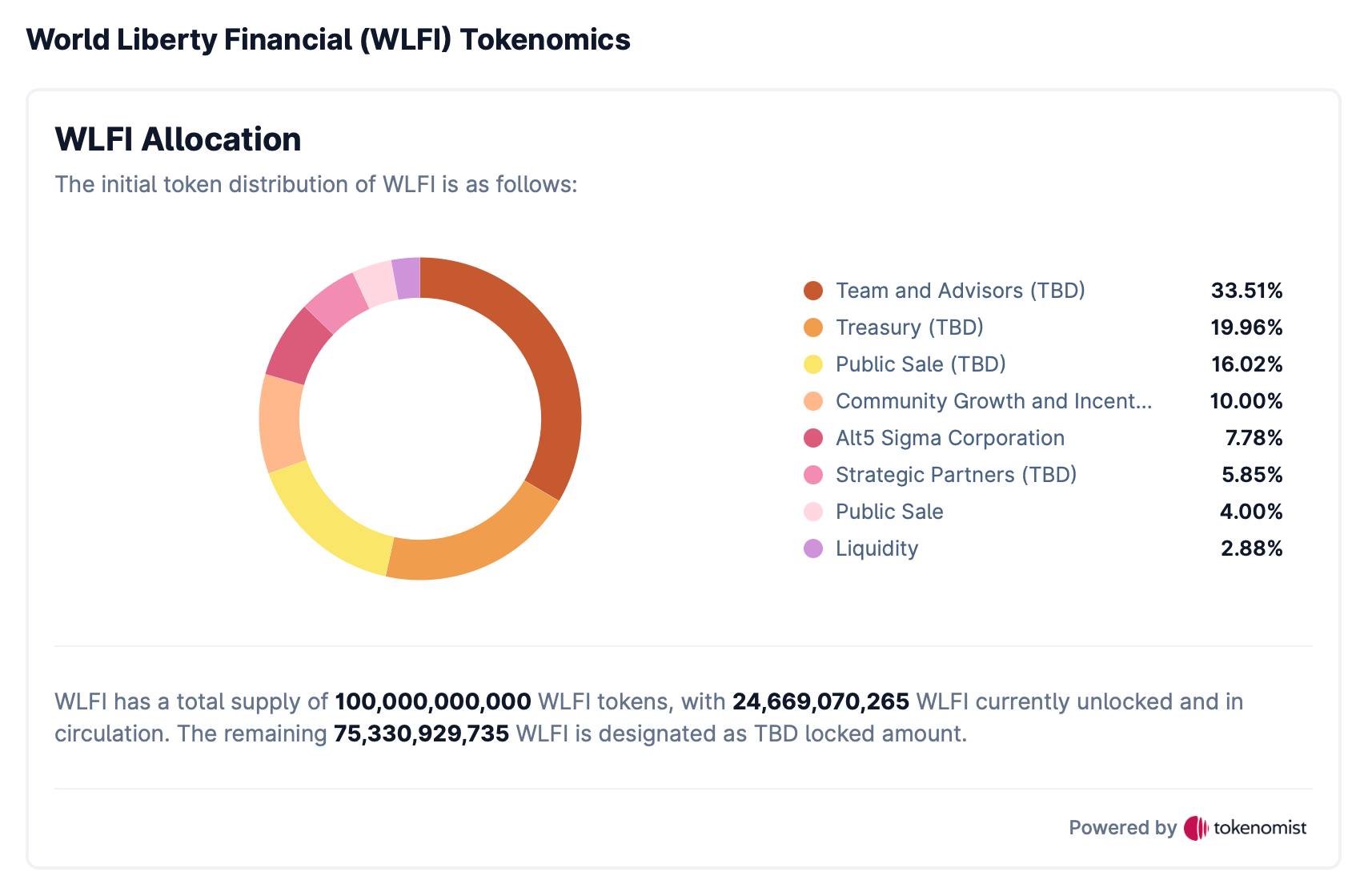
WLFI has a fixed supply of 100 billion tokens, with roughly 24.67 billion currently in circulation and the remaining 75.33 billion still locked. The allocation is heavily weighted toward insiders and reserves, with 33.51% assigned to the team and advisors, 19.96% to the treasury, and 16.02% earmarked for public sale. Smaller portions are distributed to community incentives (10%), Alt5 Sigma (7.78%), strategic partners (5.85%), an additional public sale tranche (4%), and liquidity (2.88%).
Official TRUMP and MELANIA Meme Coins
Two additional entries in the Trump family’s crypto portfolio include the official TRUMP and MELANIA meme coins, both introduced on Solana in January 2025, just days ahead of Donald Trump’s second inauguration.
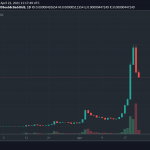
TRUMP debuted on Jan. 17, 2025, and within days climbed from fractions of a cent to an all-time high in the $73 to $75 range, briefly placing its market capitalization between $12 billion and $15 billion. That trajectory proved short-lived. By mid-2025, the token had declined by roughly 90% from its peak, and by April 11, 2026, TRUMP trades near $2.80 to $2.90, marking a drop of approximately 96% from its high. The token appears to be seeing modest price support tied to anticipation surrounding the upcoming meme coin gala at Mar-a-Lago.
MELANIA’s launch followed two days later, launching on Jan. 19. It reached an all-time high near $13.73 before reversing course. By early 2026, the token trades between $0.10 and $0.17, reflecting a decline of roughly 99% from its peak. Its market capitalization currently ranges from $100 million to $160 million.
Both tokens exhibit a familiar meme coin pattern: concentrated early trading activity, rapid price discovery, weighted token structures, and an extended downturn largely borne by retail participants. The controlling entities, CIC Digital LLC and Fight Fight Fight LLC for TRUMP, and MKT World LLC for MELANIA, were structured from inception to capture trading fees and benefit from phased token unlocks. Both continue to see active trading on Solana-based decentralized exchange ( DEX) platforms.
American Bitcoin Corp. (Nasdaq: ABTC)
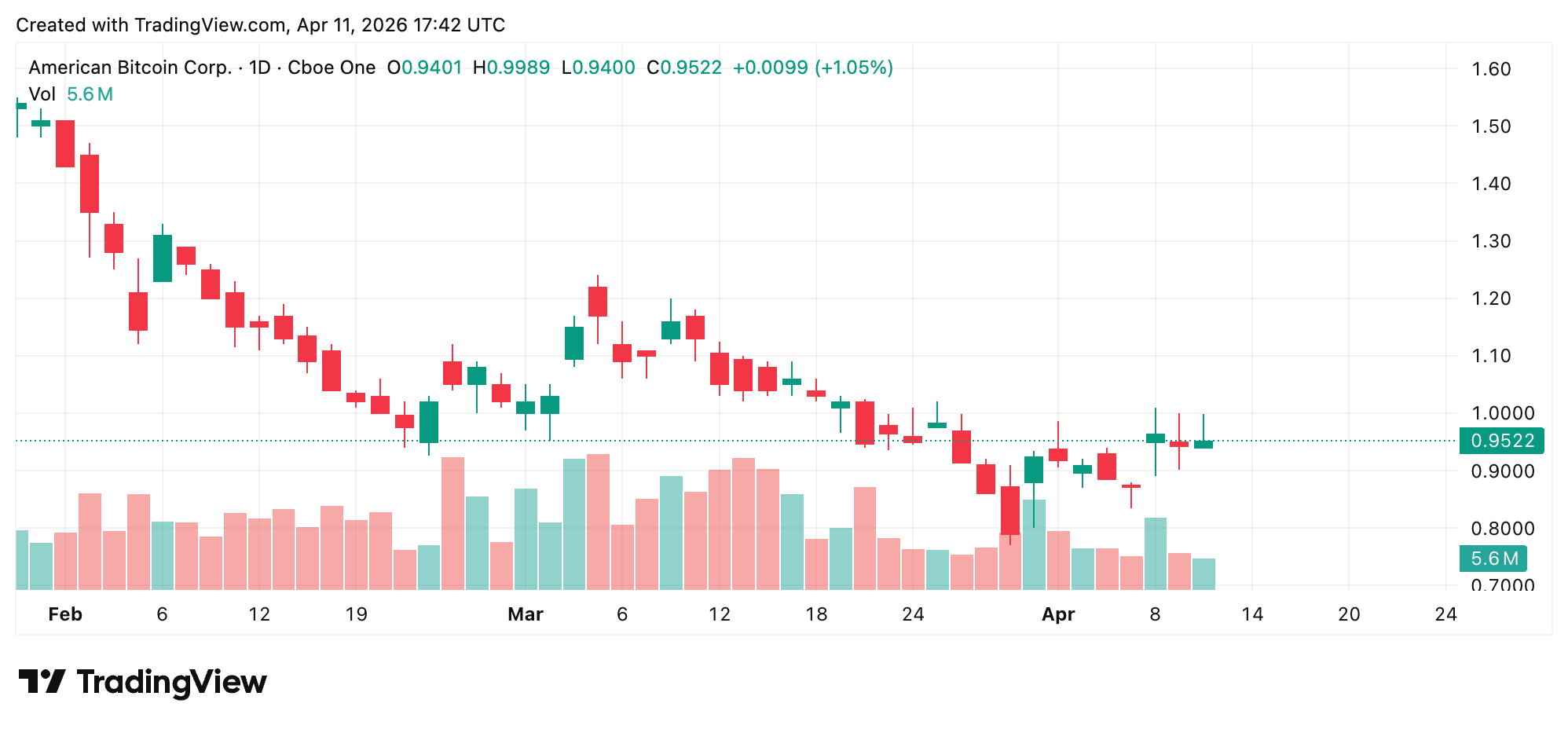
American Bitcoin Corp. is a publicly traded bitcoin mining and treasury firm that entered the public markets on Sept. 3, 2025, through an all-stock merger with Gryphon Digital Mining, debuting on Nasdaq under the ticker ABTC. The stock opened above $9 and initially moved higher before reversing course. By April 2026, it trades in the $0.90 to $1.00 range, representing a decline of roughly 84% to 93% from its post-IPO highs, with a market capitalization now below $1 billion.
The company was established in March 2025 through a partnership between Hut 8 Corp. and the Trump family. Eric Trump serves as co-founder and chief strategy officer, while Donald Trump Jr. is also a co-founder and investor. Hut 8 retains an 80% ownership stake, with the Trump family and legacy shareholders from the prior American Data Centers venture holding the remaining approximately 20%.
Operationally, the firm reported approximately $185 million in revenue for 2025. Its owned fleet totaled roughly 89,242 ASIC miners, representing about 28.1 EH/s of total hashrate, with operational output ranging between 21.9 and 25 EH/s. A March 2026 expansion added 11,298 new miners at its Drumheller, Alberta facility, contributing an additional 3.05 EH/s. The company also reported a 53% gross margin on mined bitcoin in Q4 2025.
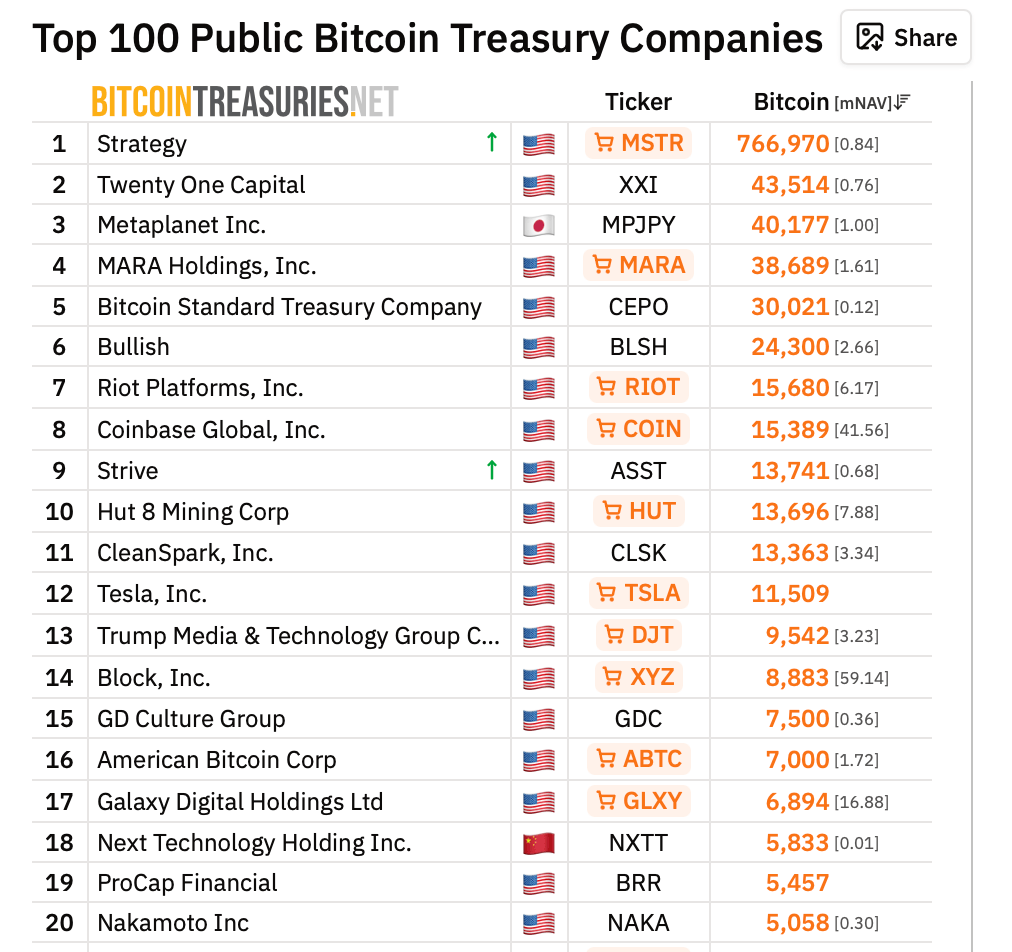
Its bitcoin treasury expanded to approximately 5,401 BTC by the end of 2025 and reached 7,000 BTC by March 2026, with a portion pledged as collateral for hardware acquisitions. The firm tracks a proprietary metric known as “Satoshi Per Share” as a central gauge of shareholder value.
The Broader Picture
The Trump family’s crypto ventures extend across nearly every segment of the digital asset sector: NFT collectibles, a DeFi platform, a stablecoin, a governance token, two meme coins, and a publicly traded bitcoin mining firm. Each debuted during periods of heightened interest in its respective category, and most have since recorded steep pullbacks from their peak valuations.
Where the crypto ventures head from here remains an open question. The trajectory will likely hinge on broader market conditions, regulatory developments, and whether any of these ventures can establish lasting utility or sustained demand beyond initial attention cycles. For now, the portfolio reflects a cross-section of crypto’s most active sectors, with outcomes that remain fluid and far from settled.
Naturally, because of the Trump name, each venture is now under close scrutiny, drawing attention not only from crypto market participants but also from outside observers tracking how these high-profile experiments unfold.