Key Takeaways
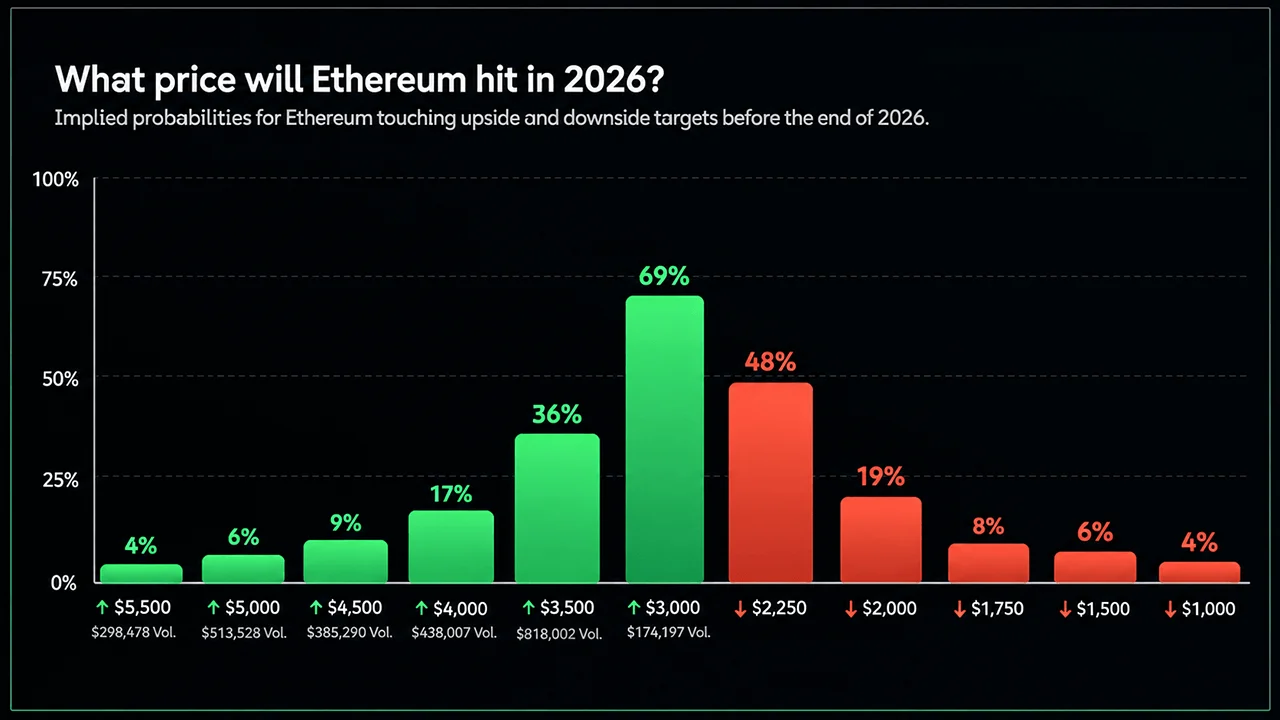
- Polymarket traders price ethereum hitting $3,000 at 70%, with $16.12 million in market volume.
- Solana’s $140 target carries 60% odds, while zcash reaching $2,000 stands at 41%.
- Kalshi puts zcash finishing 2026 above $1,000 at 73%, with just $3,679 traded.
Crypto Traders Put Millions on the Line Before 2027
With fewer than 100 days remaining in 2026, cryptocurrency prediction markets have developed a peculiar split personality. Traders are wagering that ethereum (ETH), solana (SOL) and zcash (ZEC) can reach considerably higher prices before December ends, yet the contracts measuring where those assets actually finish the year tell a different story.
On Saturday morning, Sept. 26, ethereum traded around $2,689, solana fetched approximately $121.16 and zcash changed hands near $1,543. Across Polymarket and Kalshi, traders have placed millions of dollars into contracts tracking everything from modest recoveries to spectacular price targets. The interesting part isn’t merely how high these bets go. It’s what happens when the market distinguishes between briefly touching a price and actually holding it.
Ethereum Traders Eye $3,000, but $4,000 Is Another Matter
Ethereum’s price prediction event commands the largest pool of trading activity among the three cryptocurrencies we examined, with approximately $16.12 million in accumulated volume on Polymarket’s 2026 ETH price-target market. At Saturday’s reference price of roughly $2,689, traders assigned a 70% implied probability to ethereum reaching $3,000 before the year ends. That’s a gain of approximately 11.6% from its current position.
The enthusiasm begins thinning out further up the price ladder. The $3,500 target carries 36% odds, while $4,000 sits at 17%. By $5,000, the probability has dwindled to 6%, and the $10,000 contract commands just 1%. The downside tells its own story. Traders price a decline to $2,250 at 35%, while a fall to $2,000 carries 15% odds. Even the $1,000 contract remains active, although its implied probability stands at just 5%.
Here’s where the numbers get interesting. The $1,500 downside contract has accumulated approximately $3.03 million in trading volume, while the $1,000 contract has attracted another $2.21 million. Those figures measure cumulative trading activity, not the amount currently wagered on a decline or the number of traders expecting one.
Kalshi’s 2026 ETH price market presents a somewhat different picture. Its ethereum year-end market carries roughly $12.17 million in volume and displays a forecast price of $2,720. The exchange’s individual closing-price brackets show 14% odds for ethereum (ETH) finishing between $2,500 and $2,749.99, followed by 13.6% for the $2,750 to $2,999.99 range. In other words, touching $3,000 and closing the year above it are two different propositions.
Solana’s $140 Target Draws Attention as $200 Bets Remain Alive
Solana’s prediction markets offer another curious set of figures. With SOL changing hands around $121, Polymarket traders assign a 60% probability to the cryptocurrency reaching $140 before January.
The $160 target commands 32%, while $180 carries 19%. By $200, the odds fall to 12%, leaving traders pricing a relatively modest chance of a roughly 65% advance from Saturday’s spot price. The market has attracted approximately $2.08 million in cumulative trading volume. Its most ambitious upside contract, $600, carries 1% implied odds despite accumulating $154,564 in trading activity.
On the other hand, the $90 downside contract carries 26% odds, while a decline to $80 stands at 18%. Traders assign an 8% probability to SOL touching $60 before the deadline. Kalshi’s year-end SOL contract paints another picture entirely. Its market displays a $128.90 forecast, with 71% odds that SOL finishes at $100 or higher, 34% for $150 or higher and 27% for $200 or higher.
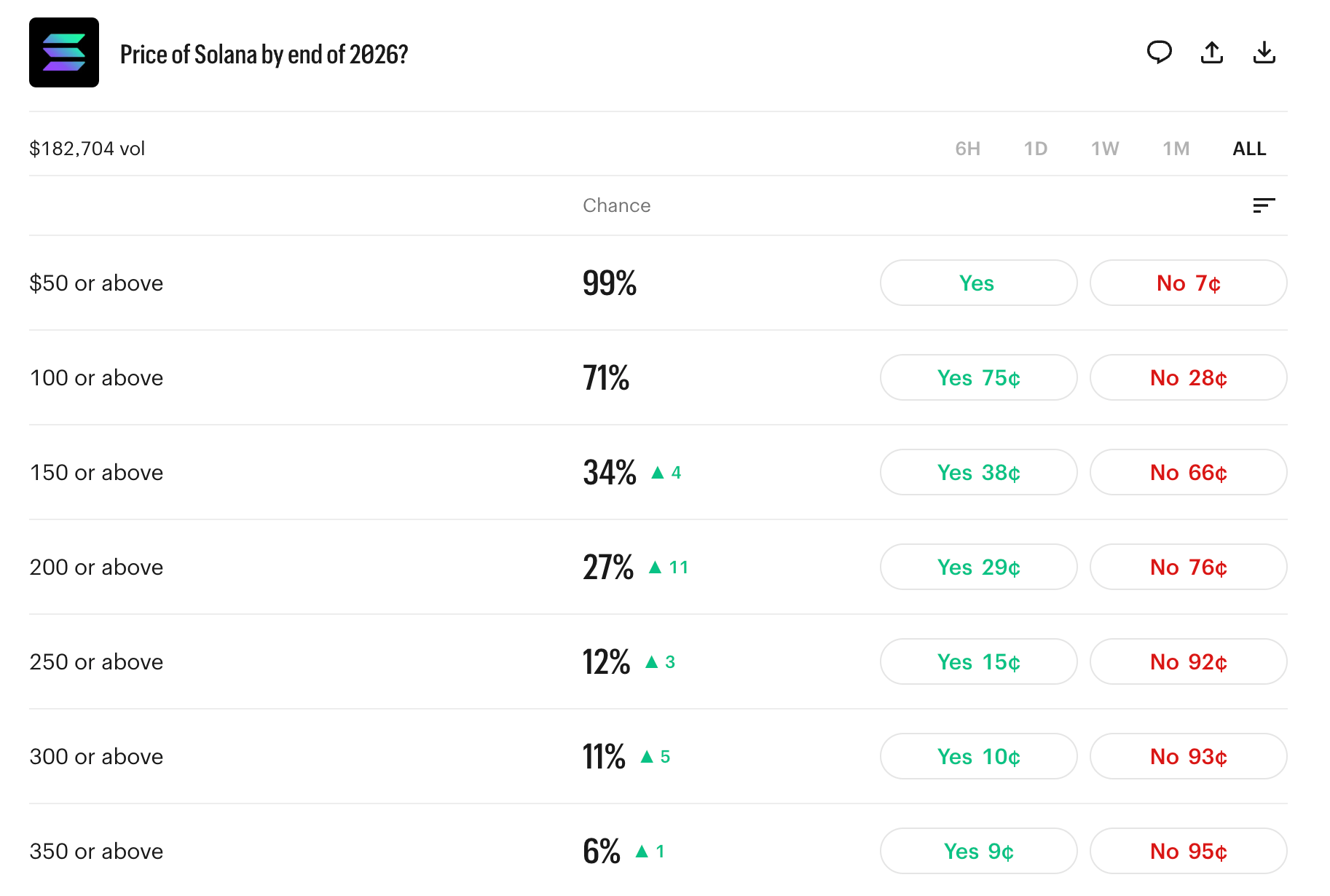
The latter contract has recorded an 11-percentage-point increase in its displayed probability, according to the supplied market snapshot. One important qualification should be noted. Kalshi’s solana market has recorded just $182,704 in total volume, considerably less than the corresponding Polymarket event. Those probabilities reflect trading in a relatively small market, not what investors as a whole actually think.
Zcash’s $2,000 Bet Meets a Curious $1,000 Year-End Forecast
The privacy-centric digital asset zcash delivers perhaps the most intriguing contradiction of the bunch. Trading around $1,543 on Saturday, ZEC has already cleared the $1,400 and $1,500 milestones tracked by Polymarket’s 2026 ZEC event. Its next major upside target, $2,000, carries a displayed implied probability of 41%. That would require a gain of approximately 29.6% from its current price. The market has accumulated $647,359 in trading volume across 24 outcome brackets.
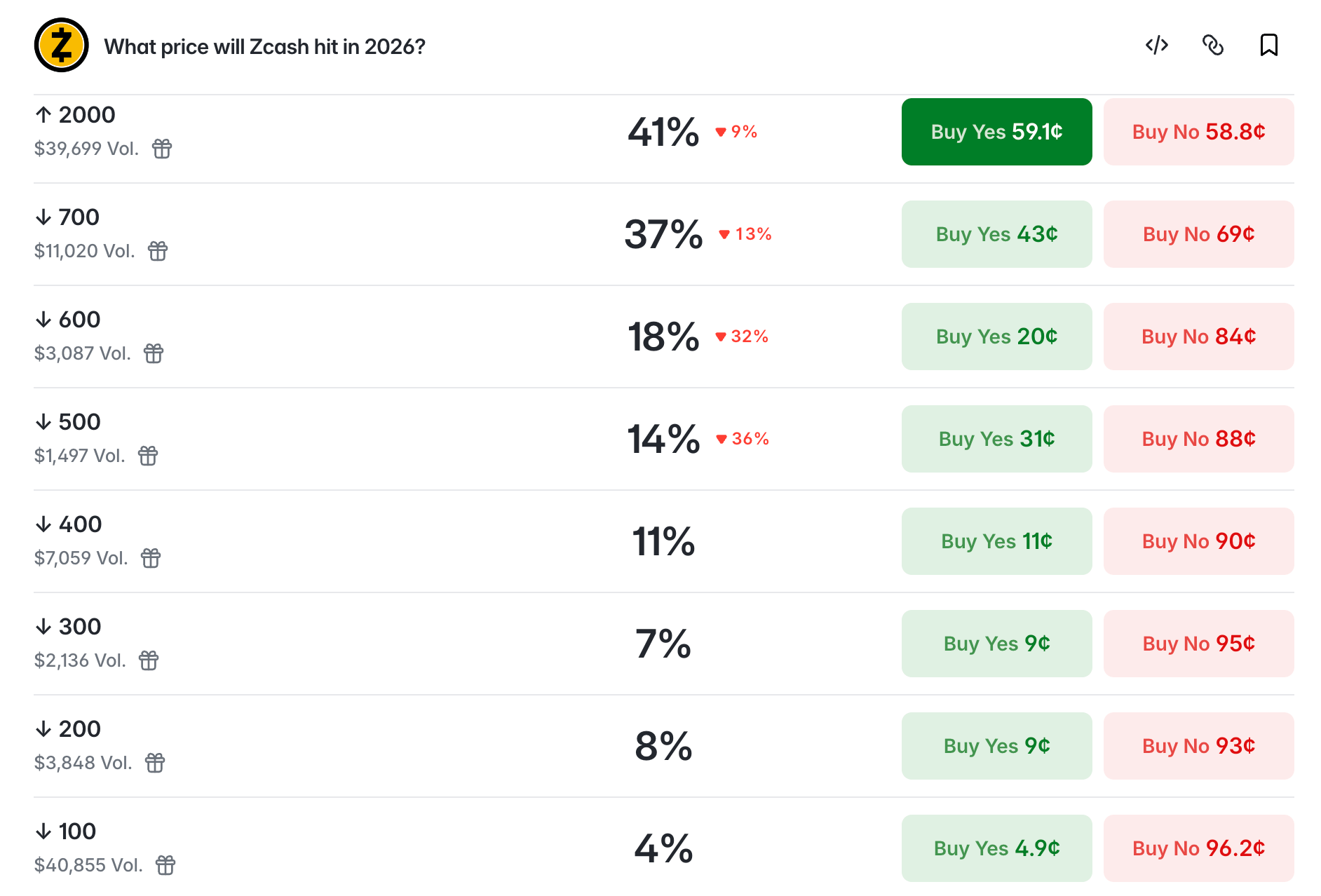
Yet traders are also entertaining the possibility of a considerable retreat. The $700 downside contract carries 34% odds, while the $500 target stands at 22%. Even a return to $100 has a 4% implied probability. Kalshi’s year-end zcash market adds another wrinkle. Its $1,000-or-higher contract displays 73% odds, despite ZEC already trading comfortably above that threshold.
The distinction is important. Polymarket’s $2,000 contract asks whether zcash touches that price at any point before the deadline. Kalshi’s $1,000 contract asks whether the cryptocurrency finishes the year above that level. A cryptocurrency can satisfy both conditions. ZEC could briefly trade at $2,000, retreat and still finish December above $1,000.
There is another catch worth mentioning. Kalshi’s zcash event has accumulated only $3,679 in volume. Its $1,000 contract also displays a 75-cent Yes price and a 40-cent No price, reflecting a particularly wide quoted spread. That makes its 73% displayed probability a market snapshot rather than a definitive measure of collective expectations.
The Fine Print Changes Everything
The distinction between these two prediction marketplaces is more than bookkeeping. Polymarket’s contracts use Binance’s one-minute trading candles to determine whether a cryptocurrency reaches a specified price. An upside contract resolves to Yes when a qualifying candle records a high equal to or greater than its target. Downside contracts use the corresponding low. Once a qualifying price is recorded, the target resolves successfully. The cryptocurrency doesn’t have to remain there.
The prediction market Kalshi’s year-end contracts operate differently. They rely on CF Benchmarks’ real-time price indexes, using the average of 60 consecutive one-second observations immediately before midnight Eastern on Jan. 1, 2027. That means a brief price spike in November might settle a Polymarket contract without having any bearing on the eventual outcome of a Kalshi closing-price wager.
Three Cryptocurrencies, One Unanswered Question
Taken together, the weekend’s prediction marketplace snapshots covering ETH, SOL, and ZEC account for a significant $31.22 million in cumulative trading volume across the six distinct Polymarket and Kalshi events.
The next three months will determine which contracts pay out, but the year-end settlement rules leave another question hanging over the market. Traders can collect on a cryptocurrency price reaching a particular U.S. dollar value even if it subsequently gives back every penny of that advance. Getting there is one thing. Staying there is quite another.