
Key Takeaways
- Michael Egorov called Pump.fun “a casino of scams,” criticizing its memecoin culture on Solana.
- Egorov said Phantom’s hardware-wallet setup trails Metamask’s despite Solana’s ecosystem support.
- Claw Pump co-founder Tomi204 pushed back, defending Pump.fun and Phantom’s average-user experience.
Blunt Critique at Its Finest
Michael Egorov, the founder of Curve Finance, has taken direct aim at two of Solana’s most prominent consumer products, describing Pump.fun, the memecoin launchpad that has become nearly synonymous with Solana’s retail trading culture, as “a casino of scams called memecoins.”
His complaint wasn’t with Solana itself, stating that the Solana Foundation does a strong job supporting its ecosystem, but he argued its flagship consumer applications don’t hold up to scrutiny.
Phantom, Solana’s most widely used wallet, got a separate and more specific complaint. Egorov said connecting Phantom to a hardware wallet was difficult, and while the connection ultimately worked, the overall experience was far worse than what Ethereum users get with Metamask.
In any case, it bears mentioning that Curve lives on Ethereum and competes for the same liquidity that flows through Solana’s decentralized finance (DeFi) ecosystem.
The Pushback
The criticism didn’t go unanswered as Tomi204, co-founder of Claw Pump, responded that Pump.fun only provides infrastructure and that users, not the platform, decide how to use it responsibly. On the wallet complaint, Tomi204 argued Phantom may actually be the better option for average, non-technical users, even if the hardware wallet integration has rough edges for power users like Egorov.
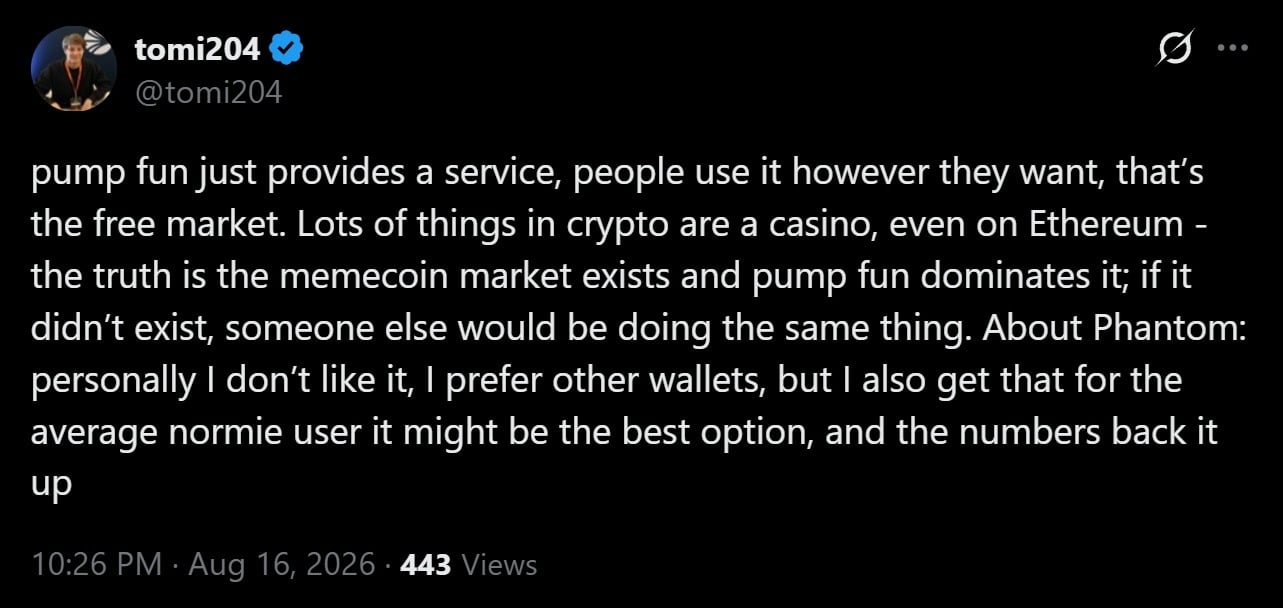
Egorov followed up by arguing that wallets and other consumer software tend to degrade in quality once they reach a certain scale, suggesting the friction he ran into may reflect growing pains rather than a fundamental design flaw.
The exchange stayed relatively civil by Crypto Twitter standards, but it did tap into a real fault line in the industry, i.e. whether platforms that make it trivially easy to launch and trade speculative tokens bear any responsibility for the scams and rug pulls that inevitably follow, or whether that responsibility sits entirely with the traders who choose to participate.
Egorov’s Pattern of Calling out DeFi
This isn’t the first time Egorov has used his platform to criticize how the rest of the industry handles security and user experience. Earlier this year, he called for industry-wide security standards after a wave of decentralized finance (DeFi) exploits exposed a recurring weakness in protocols relying on centralized points of failure inside systems supposed to be trustless.
For Pump.fun, the criticism arrives at an awkward moment given that the platform has weathered periodic waves of scrutiny over its role in enabling low-effort memecoin launches, and public criticism from a well-known DeFi founder, even one with no direct stake in Solana’s success, adds fuel to that ongoing debate. For Phantom, the wallet UX complaint is a smaller but still notable data point as hardware-wallet integration becomes a bigger differentiator for security-conscious users moving larger sums onchain.