
Key Takeaways
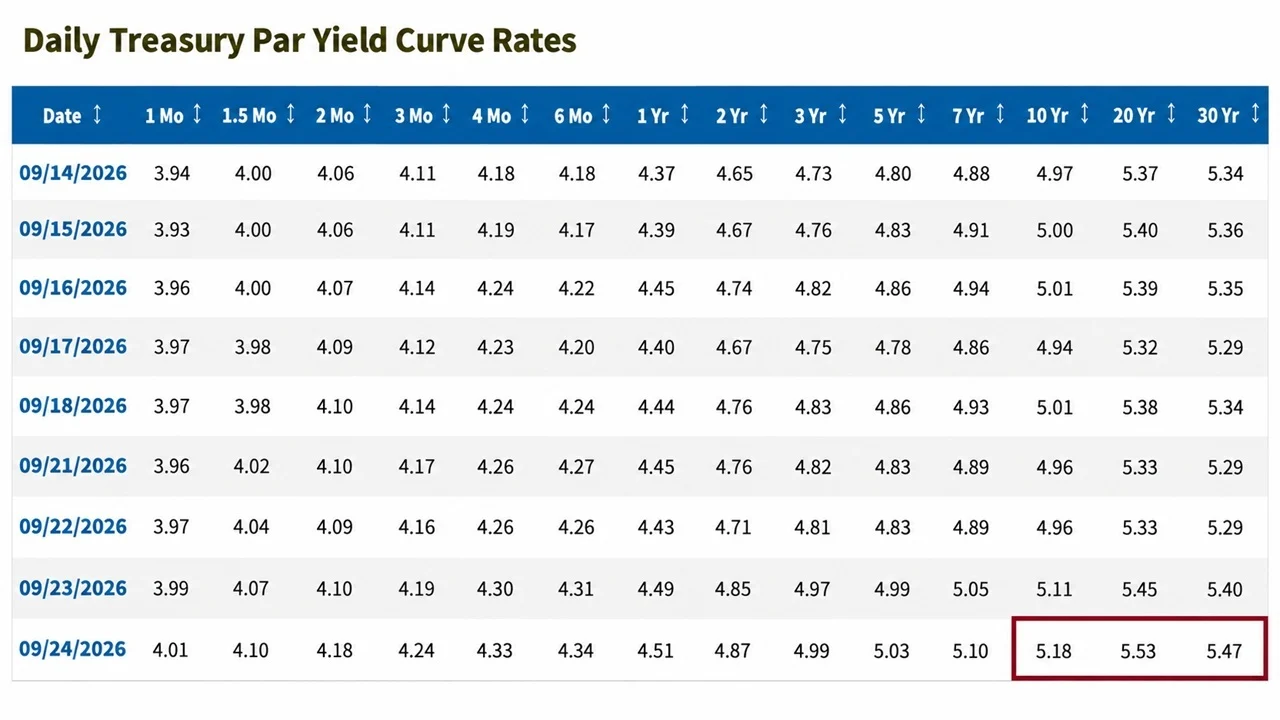
- The 10-year Treasury closed at 5.18% on Sept. 24, its highest close since July 2007.
- The MOVE index jumped from 76.2 to 104.6 in a week after the Fed’s Sept. 16 rate hike.
- Arthur Hayes says a MOVE reading above 130 would force a policy “bailout” of some sort.
The Numbers on the Screen
The U.S. Treasury’s daily yield curve shows the 10-year note closing at 5.18% and the 30-year bond at 5.47% on Sept. 24. Both are 2026 highs. The 10-year has not closed that high since July 2007, and the 30-year has not gone that high since February 2002.
The move has been fast because just a week earlier, on Sept. 17, the 10-year sat at 4.94%, so it has climbed 24 basis points in five sessions. The trigger came on Sept. 16, when the Federal Reserve raised its target range by a quarter point to 3.75%–4%. It was the first hike since July 2023, and 6 of 18 policymakers expected at least one more increase this year.
Schiff: Enjoy It While It Lasts
Gold advocate and longtime bitcoin skeptic Peter Schiff posted Thursday night that with 10-and 30-year rates at all-time highs, it’s once again the perfect time to accrue gold, adding:
“Enjoy these low rates while you can as they won’t last long. Soaring government spending, debt, inflation and de-dollarization will drive rates much higher. Got gold?”
Ackman and Armstrong: Is the Fed Feeding the Fire?
Pershing Square founder Bill Ackman went after the Federal Reserve directly and in a post argued that demand for compute and energy in the race for “super intelligence” may not respond to higher rates. If so, interest costs get embedded in everything, and hikes could stoke inflation instead of cooling it. He further noted:
I think the Fed might have just made a mistake. Am I right or am I wrong?
Coinbase CEO Brian Armstrong replied to Ackman, calling the higher rates a pathway to “higher government deficits and higher money printing (inflation).” Armstrong’s prescription:
The main thing to curtail is money printing that exceeds economic growth. And the main thing to max is economic growth.
Hayes: Watch 130
Contrary to the above three, Bitmex co-founder Arthur Hayes seems to be watching a different gauge altogether, namely the MOVE index, which tracks expected volatility in the Treasury market (the bond market’s version of the stock market’s “fear gauge”). He wrote:
The MOVE Index is surging in the right direction to force some sort of policy response. >130 and we are green lit for a bailout of some sort.
The index closed at 104.6 on Sept. 24, up from 76.2 a week earlier and the highest since March 30. The last time it cleared 130 was the April 2025 tariff shock, when it peaked near 139.9. Hayes’s read is the most openly bullish of the four, i.e. stress builds until the Treasury or Fed steps in, and liquidity follows.
So far, bitcoin’s price has ignored the bond market, currently trading above $84,000. Anthony Pompliano’s latest episode with macro strategist Darius Dale sought to explore this connection, outright asking the latter whether Treasury Secretary Scott Bessent is bluffing the bond market, and why stocks and bitcoin sit near highs anyway.