
Key Takeaways
- Blockstream paused the Liquid network layer two (L2) after roughly 4,000 BTC, worth $320 million, was withdrawn by so-called white hat hackers on Sept. 6.
- Sideswap’s Elements bug raises new security concerns after 3,996 BTC cleared its peg-out service.
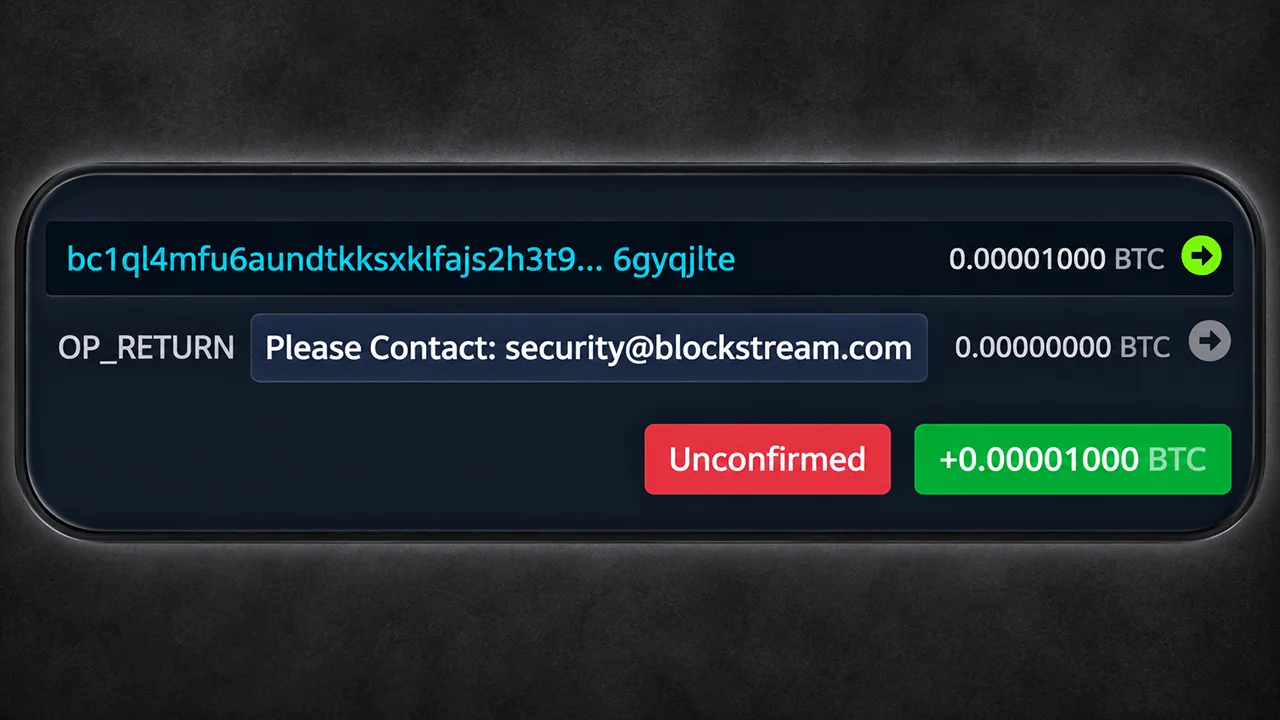
- Blockstream explained that it is in the midst of contacting the “white hats” as Liquid’s incident remains unresolved. The firm has sent a message onchain.
4,000 BTC Exit Liquid as Blockstream Scrambles to Contain Exploit
On Sunday afternoon, the onchain sleuth Ergo BTC discovered that Blockstream’s Liquid network had been exploited and following that alert, several others began sharing the news. Bitcoin.com News reported on the story at 3:17 p.m. EDT on Sept. 6, and since then, Liquid’s maintainers have confirmed the exploit. At 4:25 p.m., Blockstream noted that roughly 4,000 BTC (about $320 million) was withdrawn, and apparently, the action was carried out by white hat hackers.
Basically, white hat hackers are ethical cybersecurity experts who sometimes exploit vulnerabilities like this one to show it can be done before actual criminals exploit the same weakness. Blockstream said that the network has been paused, and exchanges have been told to halt L-BTC deposits and withdrawals.
The firm also noted that it is attempting to contact the white hats onchain. In addition to the Liquid Network X account, Sideswap.io also revealed that someone exploited a bug in Blockstream’s Elements software.
“Today at 14:05 UTC, a customer sent 4,000 L-BTC to the SideSwap peg-out service,” Sideswap’s X account wrote on the social media platform. “Our service processed it like any other order: the L-BTC was burned on Liquid with a valid peg-out authorisation, and at 14:28 UTC, the Liquid Federation paid 3,996 BTC to the customer’s Bitcoin address. Blockstream has since established that the L-BTC in that order was created through a bug in the Elements software.”
Questioning the ‘White Hat’ Claim
The crypto community was not so kind after this event, and several accounts on X criticized the project. “Kick this software [to] the curb, you’re toast,” one individual wrote in reply to Sideswap’s message. Alongside this, Blockstream responded onchain and wrote, “Please contact security@blockstream.com” in an OP_RETURN message. Ledger CTO Charles Guillemet explained that the so-called white hat hackers’ moves do not look like a typical white hat.
“They now ask to be contacted on Signal. It doesn’t look like usual white hats practices, but usual criminal orgs don’t usually try to contact their victims either. There’s hope. [These] could be people with good intentions that intensively played with recent LLMs and are not used to responsible disclosures,” Guillemet said on X.
Liquid Fallout Hits Aqua as Samson Mow Details the Impact
Samson Mow, the CEO of JAN3, the bitcoin technology firm that developed the Aqua Wallet, also shared his two cents. “The working theory is that the vulnerability is with Liquid’s Confidential Transactions, but devs cannot confirm at this time. The vulnerability is a node level isue and is not related to PAKs or HSMs,” Mow wrote. He further stated that his product Aqua, is impacted.
“Everyone is actively working to resolve this and we’ll share information as the situation develops. As a Liquid BTC wallet, Liquid functionality in Aqua Bitcoin is impacted, but Bitcoin transactions will still work normally. These are difficult times but we’ll pull through.”
Liquid Exploit Puts Sidechain Security Under the Microscope
2026 has been a hell of a year for exploits and hacks, and this incident just throws salt on the wounds. It also focuses on sidechains, bridges, technical bugs, and governance fragility as well. The fact is, a well known federated sidechain pausing for manual intervention is a pretty big deal, and it’s quite unusual. Especially a product crafted by a BTC firm with a $3.2 billion valuation. It’s safe to say that with all of these exploits in the crypto space, like the recent Coldcard firmware bug, confidence is eroding.
Alongside this, artificial intelligence (AI) or Large Language Models (LLMs) are being accused once again of finding this specific exploit, despite the fact that Blockstream has not said how this bug was discovered. People are still speculating. At the same time, while LLMs are powerful pattern-matchers and can catch vulnerabilities, a case like this likely required deep, contextual protocol intuition. Meaning, while the AI probably helped, a human definitely pulled the trigger.