Key Takeaways
- Bitcoin’s fall below $70,000 reflects mounting pressure from exchange-traded fund (ETF) outflows, shrinking stablecoin liquidity and weakening institutional demand.
- Approximately $1.64 billion in crypto liquidations compounded the downturn, while recent buyers and long-term holders contributed to selling pressure.
- Oversold technical indicators, whale accumulation and reduced leverage offer potential recovery signals, but a sustained reversal remains unconfirmed.
Bitcoin’s price retreat to $66,397 on Bitstamp on Nov. 13, at 11 p.m. Eastern time, marking its lowest level since August, extending a punishing decline that has erased approximately 46% of its value since the October 2025 record of more than $126,000. The downturn has also brought renewed scrutiny to the leading crypto asset’s underlying market structure, particularly the disappearance of institutional demand that previously helped sustain higher valuations.
The selling has hardly occurred in isolation. Inflation concerns, a strengthening dollar, persistent exchange-traded fund (ETF) withdrawals, and contracting stablecoin supplies have converged with an increasingly fragile derivatives market. Together, these developments have created conditions in which relatively modest selling can produce disproportionate price movements.
Lacie Zhang, research lead at Bitget Wallet, told Bitcoin.com News that bitcoin’s price decline could deepen if mounting economic pressures and continued ETF withdrawals overwhelm remaining support levels. Zhang identified $68,000 as the immediate threshold, followed by $65,000 to $66,000, with further losses potentially exposing considerably lower prices.
“A decisive break below that zone could expose $62,000-$63,000,” she warned. Conversely, Zhang identified $72,000 to $74,000 as the first significant resistance area, suggesting that any meaningful recovery would need to overcome those levels before confidence could return.
Nevertheless, the bearish argument is not without its contradictions. Certain whale cohorts have resumed accumulating bitcoin, leveraged positions have been substantially reduced, and several technical indicators have entered territory historically associated with exhausted selling. Whether these developments represent the beginnings of a recovery or merely temporary relief remains an open question.
Bitcoin’s Bearish Case Runs Deeper Than a Technical Breakdown
The Federal Reserve sits near the center of the prevailing uncertainty. October’s core consumer price index (CPI) increased 0.3%, exceeding the anticipated 0.2% advance, while producer price inflation reinforced concerns that monetary policy could remain restrictive. Expectations of additional tightening have complicated the outlook for speculative investments, particularly those offering no conventional yield.
Compounding the problem, the U.S. Dollar Index climbed above 103, approaching its strongest reading in approximately 19 months. Rising Treasury yields have added another layer of competition for investment capital, encouraging investors to reconsider exposure to assets traditionally sensitive to financial conditions.
Institutional participation has deteriorated massively alongside the macroeconomic backdrop. U.S. spot bitcoin ETFs recorded approximately $1.44 billion in withdrawals across five trading sessions between Nov. 5 and Nov. 11, followed by additional outflows. The reversal is particularly consequential because these investment vehicles previously represented a substantial source of incremental demand.
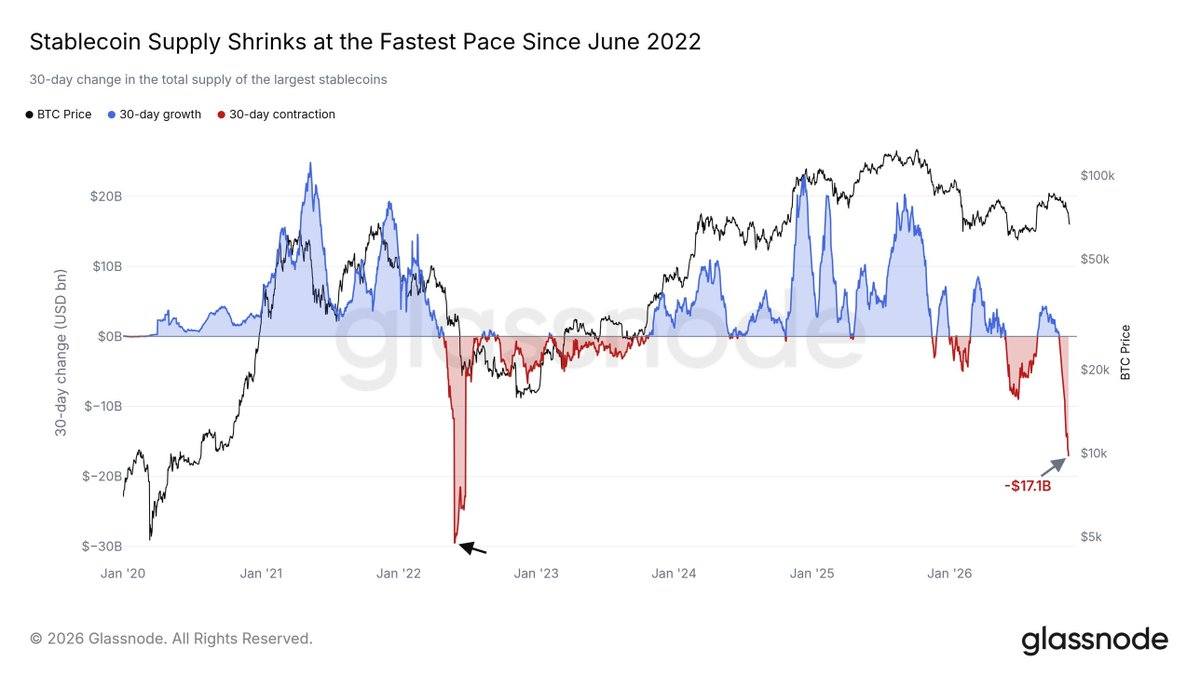
Stablecoin liquidity tells an equally troubling story. Glassnode reported a $17 billion contraction in stablecoin supplies over 30 days through Nov. 14, the sharpest decline since 2022. Rather than remaining available for cryptocurrency purchases, capital appears to be leaving the broader digital asset market, reducing the liquidity available to absorb selling.
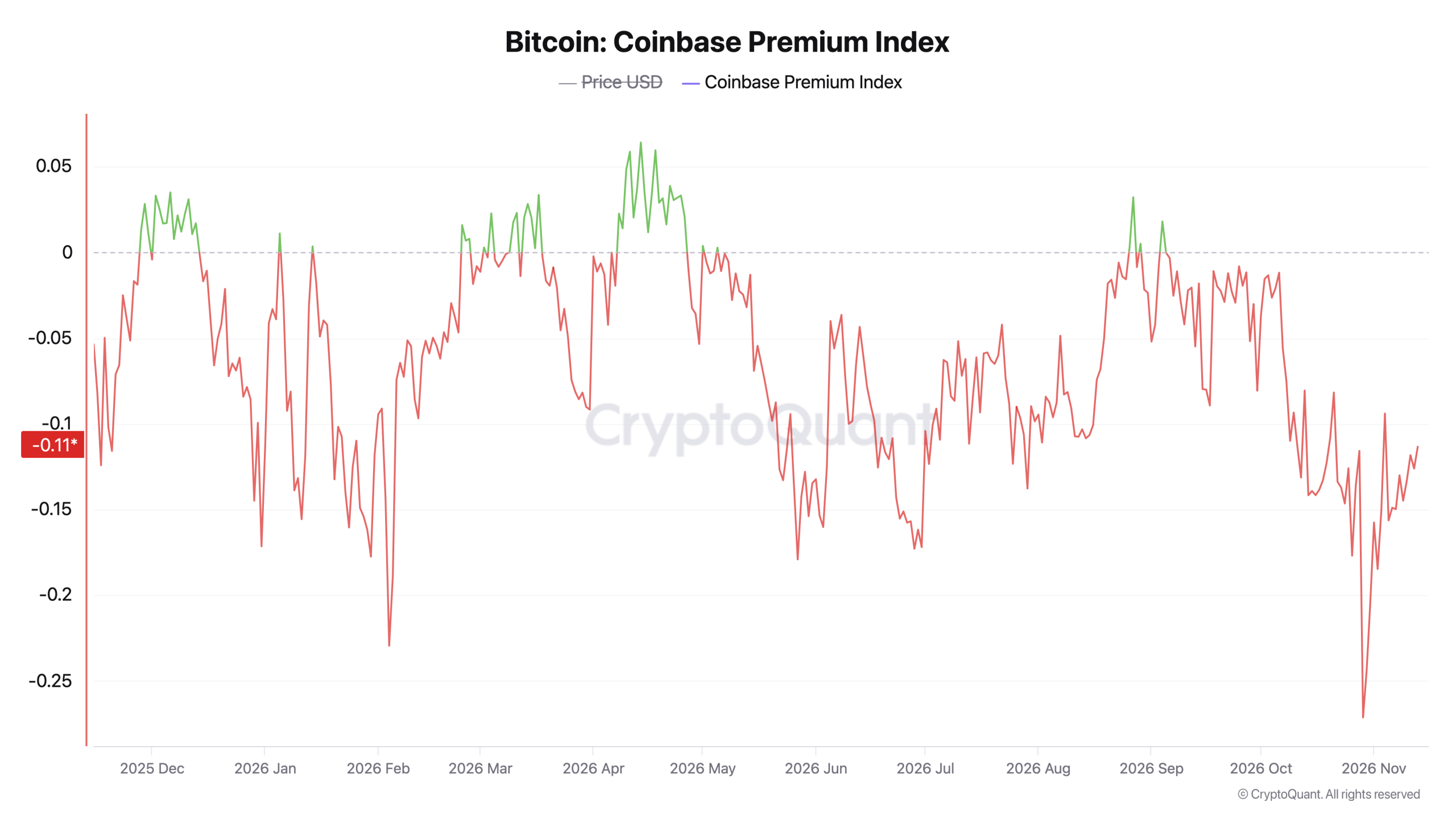
Meanwhile, Cryptoquant’s Coinbase Premium Index remained negative, suggesting that U.S. buyers were paying less for bitcoin than their counterparts on offshore exchanges. The combination creates a difficult predicament: institutional demand is weakening precisely as available trading liquidity contracts.
Derivatives markets have magnified these problems. Approximately $1.64 billion in cryptocurrency positions was liquidated during a 24-hour period surrounding the Nov. 13 decline, with bullish positions accounting for nearly 90% of the damage. Bitcoin represented roughly $916 million of those liquidations.
Ten Bearish Forces Behind Bitcoin’s Decline
| Bearish Catalyst | Market Implications |
|---|---|
| Federal Reserve tightening fears | Higher borrowing costs and weaker risk appetite |
| Strengthening U.S. dollar | Tighter financial conditions |
| Spot bitcoin ETF withdrawals | Reduced institutional buying |
| Stablecoin supply contraction | Less available trading liquidity |
| Declining apparent demand | Supply outpacing estimated absorption |
| Negative Coinbase premium | Weak U.S. spot participation |
| Leveraged liquidations | Forced selling accelerates declines |
| Short-term holder losses | Recent buyers capitulate |
| Thin liquidity and holder distribution | Greater sensitivity to selling |
| Technology-sector weakness | Broader retreat from speculative assets |
Selling has also extended beyond leveraged traders. Bitcoin’s retreat beneath the short-term holder cost basis near $75,600 has left many recent buyers underwater, while Glassnode and Cryptoquant indicators suggest that coins have increasingly been transferred or spent at losses.
Long-term investors have contributed to the pressure as well. Bitcoin.com News identified substantial distribution among established holders, while miner MARA disclosed sales of 13,597 BTC worth approximately $1.1 billion.
Thin exchange order books have further complicated price discovery, leaving fewer resting orders capable of absorbing substantial transactions. Meanwhile, turbulence in technology equities, concerns surrounding artificial intelligence valuations and uncertainty over Strategy’s index eligibility have added another dimension to bitcoin’s difficulties.
These developments do not establish a single definitive explanation for the decline. Rather, they illustrate how several independent pressures can reinforce one another when liquidity becomes scarce.
Could Bitcoin’s Worst Selling Pressure Already Be Exhausted?
Although the bearish evidence remains considerable, the opposing argument rests on an important distinction: markets frequently begin recovering before the economic or institutional conditions surrounding them have fully improved.
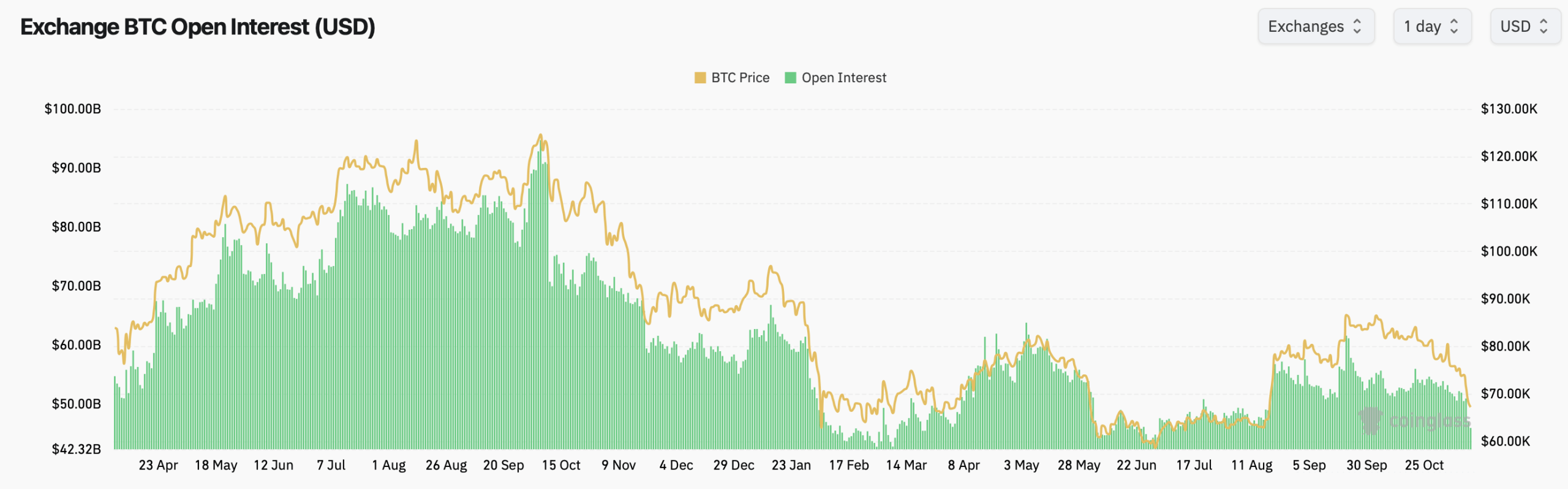
One potentially constructive development involves the reduction of speculative leverage. Bitcoin futures open interest declined considerably from late October levels, while successive liquidation events eliminated substantial concentrations of bullish positions. Reduced leverage can diminish the probability of further forced-selling cascades, although falling prices also contribute to lower dollar-denominated open interest.
Funding rates offer another potential turning point. Several major derivatives exchanges recorded negative bitcoin funding, indicating that bearish traders were becoming increasingly willing to pay for short exposure. If prices unexpectedly recover, those positions could become vulnerable to liquidations, potentially accelerating an upward move.
Technical indicators have also reached unusual extremes. Bitcoin’s daily relative strength index (RSI) approached 25, a reading commonly associated with deeply oversold conditions. The cryptocurrency simultaneously tested its 200-week moving average near $68,000, a closely watched reference for longer-term market trends.
Neither development guarantees a recovery. Oversold markets can remain oversold, and historical support levels can fail. Nevertheless, their convergence has attracted attention from analysts searching for evidence that selling pressure may be approaching exhaustion.
More encouragingly, Glassnode identified renewed accumulation among wallets holding between 100 and 10,000 BTC. These investors appeared more willing to acquire bitcoin during the downturn, even as smaller holders and certain larger cohorts continued distributing their holdings.
Corporate accumulation provides another potential source of demand. Strategy acquired an additional 1,036 BTC for approximately $81.9 million during the first full week of November, demonstrating that at least some treasury-focused buyers remained active despite deteriorating market conditions.
Bitcoin miners could eventually contribute to a recovery through a different mechanism. Falling profitability may force inefficient operators offline, producing a period of miner capitulation followed by network stabilization. Historically, such transitions have sometimes coincided with improving market conditions, although the pattern offers no reliable timetable.
Ten Potential Bitcoin Recovery Catalysts
| Potential Catalyst | Constructive Development |
|---|---|
| Reduced derivatives leverage | Fewer vulnerable bullish positions |
| Negative funding rates | Potential short squeeze |
| Oversold momentum | RSI recovery from extreme readings |
| 200-week moving average | Sustained stabilization near $68,000 |
| Whale accumulation | Broader buying among large holders |
| Corporate treasury demand | Continued institutional purchases |
| Miner recovery | Stabilizing profitability and network activity |
| Renewed ETF inflows | Consistent institutional investment |
| Stablecoin liquidity recovery | Expanding supply and positive Coinbase premium |
| Monetary and regulatory relief | Less restrictive policy and greater clarity |
Ultimately, the strongest reversal signals would come from renewed capital entering the market rather than technical indicators alone.
Sustained ETF inflows could demonstrate that institutional buyers are returning, while expanding stablecoin supplies would suggest improving liquidity. A positive Coinbase premium maintained over several weeks would provide additional evidence that American spot demand is recovering.
Macroeconomic developments could strengthen that argument. Softer inflation figures, less restrictive Federal Reserve guidance, and progress on cryptocurrency legislation could improve sentiment. However, these remain conditional possibilities rather than established outcomes.
The immediate technical challenge involves recovering several important price levels. Bitcoin’s 200-day moving average stood near $73,100 in the supplied assessment, followed by the short-term holder cost basis around $75,600 and the True Market Mean near $77,500.
Wintermute’s Jasper De Maere has identified reclaiming and holding $80,000 as a more convincing indication of renewed strength. “Bitcoin has lost $80k level. And while not for the macro reasons we flagged, the market still feels heavy post the $1.5b liquidation on the back of Binance last week,” the Wintermute executive explained at the start of the month.
Conversely, persistent weakness beneath long-term support could leave bitcoin vulnerable to another decline, with bearish assessments identifying the $57,700 region as a possible destination.
For now, bitcoin’s price occupies an uncomfortable position between deteriorating fundamentals and potentially constructive technical conditions. The leverage reset, oversold readings and selective accumulation suggest that a rebound is conceivable, but none establishes that the broader downturn has ended.
The decisive question is whether fresh capital can return quickly enough to offset continued selling. Until ETF flows improve, stablecoin liquidity expands and spot demand strengthens, bitcoin’s recovery argument remains a possibility awaiting confirmation rather than a conclusion supported by the market.