Key Takeaways
- The OCC closed United Fidelity on Nov. 27, and the FDIC expects a $1.83 billion hit to its insurance fund.
- First Citizens took $3.1 billion in loans at a $2.6 billion discount and about $4.5 billion in deposits.
- United Fidelity’s 22 branches reopen as First Citizens locations on Nov. 28 and Nov. 30.
Regulators Move on a Friday Night
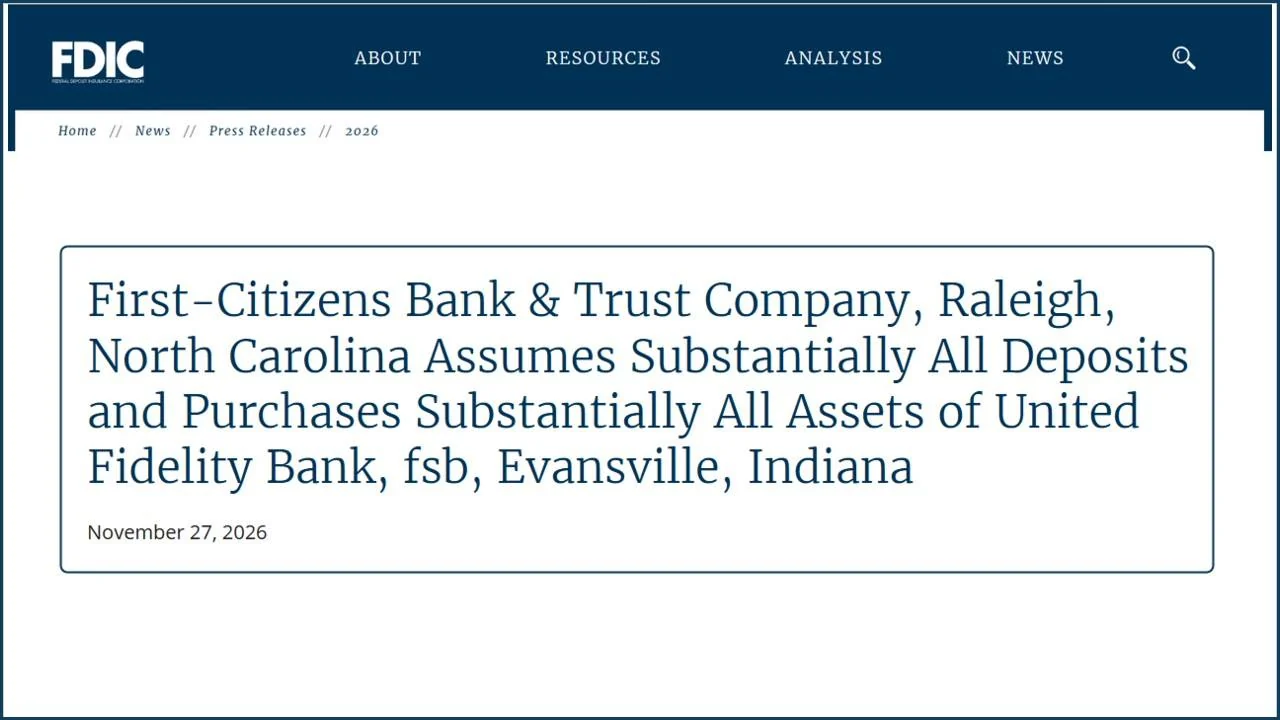
The Office of the Comptroller of the Currency (OCC) closed United Fidelity Bank, FSB, of Evansville, Indiana, and named the Federal Deposit Insurance Corporation (FDIC) as receiver. In a press release, the FDIC said First-Citizens Bank & Trust Company of Raleigh, North Carolina, agreed to assume “substantially all of the bank’s deposits and buy substantially all of its assets”.
The agency stressed that customers are protected, stating:
Depositors of United Fidelity will become depositors of First Citizens, so customers do not need to change their banking relationship and will retain all of their funds and deposit insurance coverage.
United Fidelity’s 22 branches in Indiana, Illinois, Florida, Colorado and the U.S. Virgin Islands will reopen under the First Citizens name, starting Saturday at locations with weekend hours and Monday everywhere else. The Virgin Islands branches had operated as Bank of St. Croix.
The Fine Print Points to Bad Loans
The numbers suggest United Fidelity was in deep trouble, with the FDIC estimating the failure will cost its Deposit Insurance Fund $1.83 billion. As prominent media outlets reported Friday, that is an unusually high 31% loss on the bank’s $5.9 billion in total assets as of Sept. 30.
First Citizens agreed to take on $3.1 billion of United Fidelity’s loans, but only after winning a $2.6 billion asset discount, with no deposit premium. It also assumed only about $4.5 billion of deposits, well short of the $5.4 billion the bank held at the end of September. The FDIC said certain brokered deposits will not transfer, without saying how many.
First Citizens CEO Frank Holding Jr. called the deal “both financially and strategically compelling.” It is not his bank’s first rescue, as First Citizens bought the remains of Silicon Valley Bank out of receivership in 2023.
For quite some time now, the warning signs had been visible. For starters, the OCC took enforcement action against United Fidelity in October 2023 over capital planning, risk management, and contingency funding, while the Federal Reserve issued a cease-and-desist order against its parent companies in June 2024.
Second-Largest Failure Since the 2023 Crisis
United Fidelity is the biggest U.S. bank to fail since Philadelphia’s Republic First Bank closed in April 2024 with about $6 billion in assets. It also ranks as the second-largest failure since the 2023 regional banking crisis that took down Silicon Valley Bank and First Republic.
Prediction market Polymarket flagged the news to its followers within minutes, calling it the “largest U.S. bank failure in over two years.” Prominent market commentator Mario Nawfal also weighed in on the situation, adding:
Nobody pays that kind of discount for healthy loans. One failed bank isn’t a crisis, but regulators owe Americans an answer on whether United Fidelity was one bad lender or the first crack in a bigger pile of bad loans.
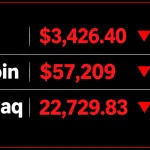
The closure adds to the already brewing uncertainty with bitcoin trading near $60,000, down roughly 2.5% since yesterday. Moreover, Bitcoin.com News reported earlier this week that global markets had bled trillions, making investors across the board increasingly more unsettled.
That said, First Citizens shares (Nasdaq: FCNCA) closed Friday at $2,173.50 and will be the first market read on the deal when trading resumes Monday. The FDIC said customers should keep using their existing United Fidelity branches until the account conversion is done, at a date not yet set.
The bigger question, however, is whether United Fidelity was a one-off occurrence, as the FDIC did not give a reason for the closure. Its next quarterly banking profile, along with any further failures on its list, will show whether troubled loans are spreading beyond a single Indiana lender.